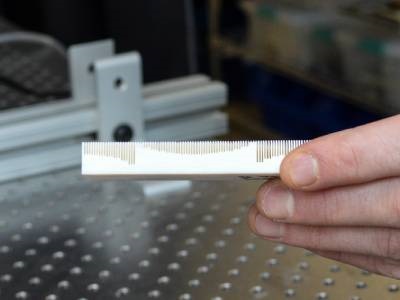
By placing a metamaterial pattern on the surface of an object, the University of Minnesota researchers were able to use sound to steer it in a certain direction without physically touching it. Credit: Olivia Hultgren
Technologies such as optical and acoustic tweezers use light and sound waves, respectively, to manipulate very small objects without physical contact. However, these technologies are limited to manipulating objects smaller than the wavelength of the sound or light – on the order of millimeters for sound and just nanometers for light. The size limitations for current noncontact manipulation methods make it challenging to integrate these methods into a range of potential manufacturing and robotics applications. Now, researchers from the University of Minnesota Twin Cities have demonstrated a new contactless approach that allows much larger objects to be moved using ultrasound.
The researchers’ method relies on the use of metamaterials that are specially engineered to interact with sound waves. By embedding a specific pattern of subwavelength-sized grooves on the surface of a larger object, the team hypothesized that the resulting metasurface could harness the force of the sound waves regardless of the object’s size. For the study, the researchers created three different metasurfaces designed to interact with ultrasound in specific ways; one metasurface experiences a sideways force parallel to the object’s surface, one demonstrates “self-guiding” by autonomously following the lateral movement of the acoustic source, and one experiences a “tractor beam” force that pulls it in toward the source of the sound waves.
Computer simulations of acoustic forces were used to help guide the design of each metasurface. Each of the metasurface objects contained 20-30 individual grooves and had a total length of several centimeters – much larger than objects typically controlled using acoustic tweezers. For each experiment, an array of piezoelectric transducers operating at 20 kHz was used as the acoustic source. The team successfully demonstrated acoustic actuation in the desired direction for all three objects, and captured these demonstrations in videos included as supplementary information for the published paper. The paper was published in Nature Communications.
“In a lot of fields of science and engineering, robotics especially, there is the need to move things, to transfer a signal into some sort of controlled motion. Often this is done through physical tethers or having to carry some source of energy to be able to perform a task,” said senior author Ognjen Ilic. “I think we’re charting a new direction here and showing that without physical contact, we can move objects, and that motion can be controlled simply by programming what is on the surface of that object. This gives us a new mechanism to contactlessly actuate things.”
The proof-of-concept demonstration of acoustic actuation using metasurfaces opens the door to designing new metasurfaces and developing technologies based on this new mode of contactless manipulation. In the future, more advanced metasurface designs could allow different types of object manipulation, such as multi-axial movement and levitation.