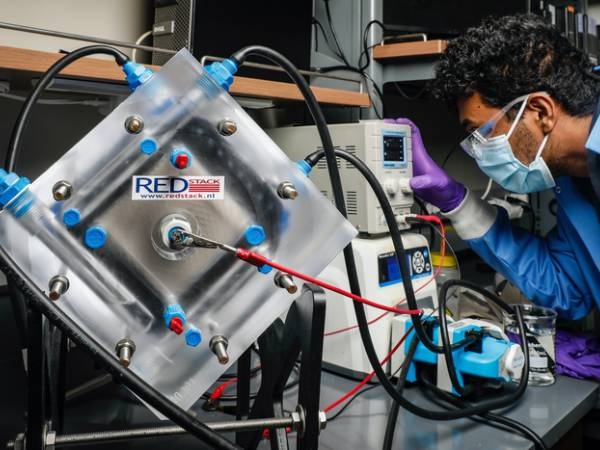
UIC graduate student Rohan Sartape in Assistant Professor Meenesh Singh’s lab, with the department of chemical engineering. Credit: Jim Young/UIC Engineering
Ethylene is a widely-used chemical in plastic production, agriculture, the automotive industry and more. Out of manufactured chemicals worldwide, ethylene production ranks third in carbon emissions, only after ammonia and cement. To both reduce emissions from ethylene production and improve the economic viability of carbon capture systems, engineers at the University of Illinois Chicago (UIC) have built an integrated machine that both captures carbon and converts it to ethylene while running only on electricity.
To capture carbon from flue gas, the researchers modified an artificial leaf system using inexpensive materials – the carbon capture system includes a moisture gradient across an electrically charged membrane. On the dry side of the membrane, an organic solvent attaches to carbon dioxide and produces a concentration of bicarbonate; the negatively charged bicarbonate ions are then pulled across the membrane toward a positively charged electrode on the wet side of the membrane. Here, an aqueous solution dissolves the bicarbonate back into CO2, which can then be released for conversion into ethylene.
The conversion system, integrated into the same machine in a closed loop, involves a current being passed through an electrochemical cell. CO2 from the capture system fills half of the cell while the other half, separated by a membrane, contains an aqueous solution. An electrified copper mesh catalyst draws charged hydrogen atoms from the water molecules into the other half of the cell, where they combine with charged carbon atoms from CO2 to form ethylene (C2H4). The team tested the system – a 100 cm2 bipolar membrane electrodialysis unit hydraulically connected to a 1 cm2 electrolysis cell – and ran it continuously for 24 hours a day for seven days, capturing carbon at a rate of 24 grams per day and producing high-purity ethylene at a rate of 188 mg per day. Further, the machine removes more carbon than it emits, making it a net-negative solution for ethylene production. This research was published in Energy & Environmental Science.
“This is the first demonstration of a net-negative, all-electric integrated system to capture carbon from pollutants and create a highly valuable resource,” said Meenesh Singh, UIC assistant professor in the department of chemical engineering. “There is an urgent need to develop efficient technologies for integrated carbon capture and conversion to sustainably produce net-negative fuels. Currently, integrated carbon capture and conversion systems are highly energy-intensive and work in a discontinuous cycle of carbon dioxide capture and reduction. Efficiently integrating carbon capture with the conversion system eliminates the need for transportation and storage, and thereby increases its energy efficiency.”
The system is designed to be modular and stackable, meaning it can easily be scaled up and down. The engineers plan to further improve the system to capture carbon and produce ethylene at higher rates, with a goal of capturing several kilograms of carbon and generating 1 kg of ethylene per day, according to Singh.