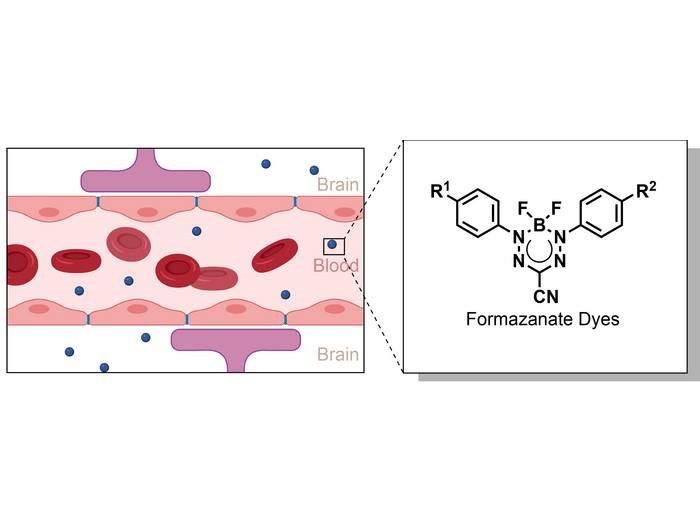
The formanzanate NIR-II small-molecule dye developed by Rice University chemist Han Xiao and collaborators is currently the only one of its kind that can cross the blood-brain barrier. Credit: Courtesy of Xiao Lab/Rice University
Second near-infrared (NIR-II) wavelengths, between 1000 and 1700 nm, allow for a high penetration depth and resolution in fluorescent imaging applications. While some NIR-II dyes are available, they have not been applicable to brain imaging due to large scaffold sizes that prevent them from crossing the blood-brain barrier. Now, researchers from Rice University and Stanford University have developed a new, bright, highly photostable NIR-II dye with a very small scaffold that allows it to cross into the brain.
The dye is made from boron difluoride (BF2) formazanate and has a more compact structure than other NIR-II dyes. Other dyes have trouble crossing the blood-brain barrier in part due to a high number of double bonds, said corresponding author Han Xiao of Rice University. To overcome this problem, the researchers modulated the aniline moiety of the BF2 formazanate dye, according to the paper. In addition to its ability to penetrate the brain, the dye also exhibits strong brightness, photostability and biological stability, and also has tunable photophysical properties and a large Stokes shift.
The authors demonstrated the use of the dye for imaging of intact healthy mouse brains and mouse models for murine glioblastoma. In the latter, the dye was successfully used to differentiate between tumors and healthy tissue. According to Xiao, the BF2 formazanate dye remains stable for more than 10 minutes after light exposure, an improvement over indocyanine green, which deteriorates within seconds. Currently, indocyanine green is the only NIR small-molecule dye approved by the FDA for use as a contrast agent. The new small-molecule design developed by the researchers could further be used to aid the delivery of other probes and drugs across the blood-brain barrier. This research was published in the Journal of the American Chemical Society.
“In the future, we could modify this scaffold and use it to look for a lot of different metabolites in the brain,” said Xiao.
Xiao added that the dye could potentially be used for imaging-guided surgery, allowing doctors to determine the boundary between healthy brain tissue and tumor tissue.