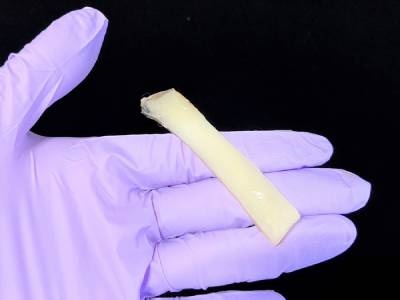
The new squid/synthetic polymer double-network gel developed in this study. Credit: Tasuku Nakajima
Hydrogels – polymer networks containing high quantities of water – are unique materials being explored by researchers in applications such as soft robotics, medical prosthetics and novel sensors. Scientists seek to develop hydrogels that closely mimic the properties of natural biological tissue, which exhibit hierarchical anisotropy, meaning they consist of a hierarchy of structures that work together and have different physical properties in different directions; currently, most synthetic hydrogels lack hierarchical anisotropy and are structurally weaker than tissues they seek to mimic, such as muscle. Now, researchers at Hokkaido University have developed a novel hydrogel that combines natural squid tissue and the synthetic polymer polyacrylamide (PAAm) to produce a strong gel with properties more similar to biological tissues.
The new hydrogel has a double-network structure, in which the PAAm network is embedded and linked within the natural muscle fiber network of squid mantle tissue. The gel was produced by treating thin slices of commercially available, defrosted squid mantle tissue with acrylamide (AAm), N,N’-methylenebisacrylamide (MBAA) and ammonium peroxydisulfate (APS) and then heating the slices at 65°C. Thermal polymerization of the squid/PAAm composite resulted in a uniform distribution of PAAm throughout the gel, which was confirmed by using Fourier transform infrared spectroscopy (FTIR) to measure spectra at multiple positions.
Squid mantle tissue includes two types of anisotropic muscles with high tensile strength, which the squid uses to expand and contract the mantle to shoot jets of water. The squid/PAAm composite retains the hierarchical anisotropy of the squid tissue while exhibiting greater toughness than both natural squid tissue and conventional PAAm hydrogels. According to corresponding author Jian Ping Gong, the double-network hydrogel is highly resistant to fracture and four times stronger than squid tissue alone, as well as more elastic. This research was published in NPG Asia Materials.
“Possible applications include load-bearing artificial fibrous tissues, such as artificial ligaments and tendons, for medical use,” said Gong.
The team is interested in exploring other types of dual-network hydrogels using other natural tissues, such as jellyfish tissue, which has previously been used to create simpler single-network hydrogels. The researchers also plan to study the biocompatibility of the gels and investigate ways to make a range of gels suitable for different uses.