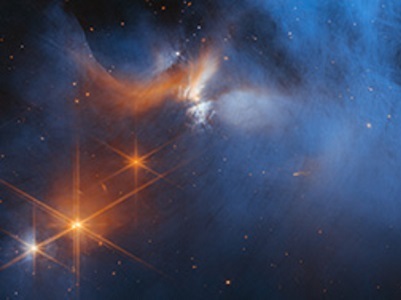
This image by the NASA/ESA/CSA James Webb Space Telescope’s Near-InfraRed Camera (NIRCam) features the central region of the Chameleon I dark molecular cloud. The lights from numerous background stars can be seen as orange dots behind the cloud. Credit: NASA, ESA, CSA, and M. Zamani (ESA/Webb)
Frozen molecules were central to the origin of life on Earth. In addition to impacts of icy comets and asteroids, according to current theory, our planet likely also received the elementary components of life from the ices of the immense interstellar molecular cloud from which the Earth and the rest of the solar system emerged.
In a new study, an international research team using images captured by the James Webb Space Telescope, discovered ice in deeper regions of such a molecular cloud than ever before. With a temperature of about -263˚ Celsius, it is the coldest ice ever measured.
"This is the first time researchers have been able to study the composition of so-called pre-stellar ices near the center of a molecular cloud," said Melissa McClure, an astronomer at Leiden Observatory and lead author of the study, published in Nature Astronomy. "In addition to simple ices such as water, carbon dioxide, carbon monoxide, ammonia, and methane, we were able to identify several other compounds, including the more complex organic ice methanol."
For the study, the team focused on the molecular cloud "Chameleon I," which is more than 500 light years away from Earth, in which dozens of young stars are currently forming. They are located near the center, in a particularly cold, dense and therefore difficult to study region.
Measurements could not be taken previously, but Webb’s high-precision infrared spectrographs (NIRSpec and MIRI) facilitated data collection. The measurements provide the research community with unprecedented insights into the abundance of icy compounds that can be found inside interstellar molecular clouds—and subsequently incorporated into stars and planets that emerge from them.
But, the data also revealed more puzzles. The researchers team found that the amount of carbon, hydrogen, oxygen, nitrogen and sulphur (CHONS) in the measured ices was less than the total budget of each element expected, based on the density of the molecular cloud. This suggests that these elements are not found exclusively in the icy components of molecular clouds, but could also be lurking elsewhere.
"The fact that we are 'missing' some of the CHONS budget could mean that CHONS are trapped in rocky dust particles, for example," said McClure. "This could allow a greater diversity in the bulk composition of terrestrial planets."
Information from University of Bern.