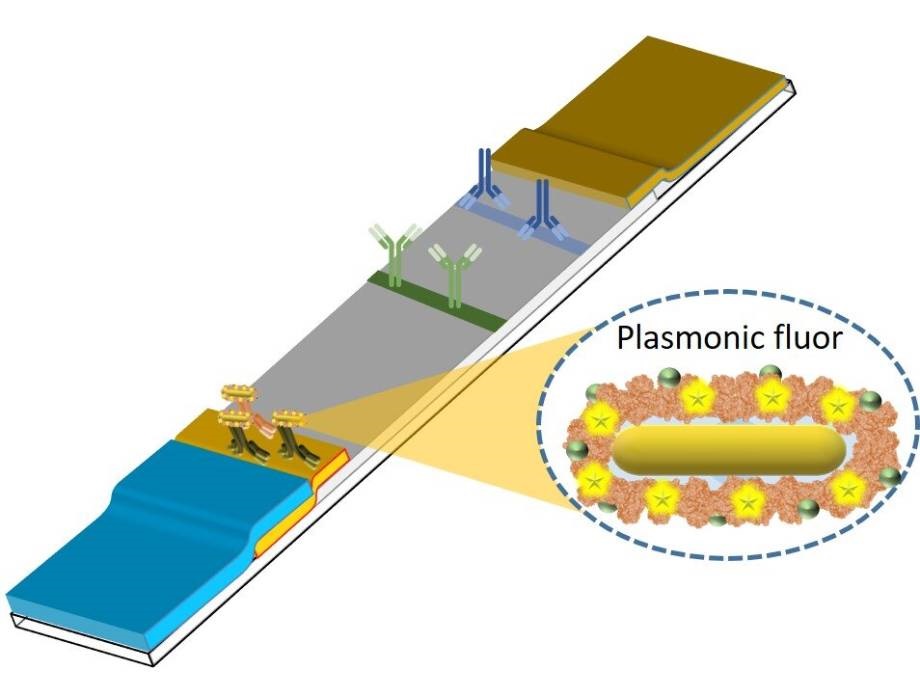
Lateral flow assays (LFAs) are used to quickly test for certain diseases at the point of care (POC) or at home, detecting antibodies or antigens and providing a simple colorimetric readout. However, lateral flow assays are significantly less sensitive and quantitative than more advanced, time-consuming and expensive laboratory tests, such as enzyme-linked immunosorbent assay (ELISA) and polymerase chain reaction (PCR), which are typically necessary to confirm a positive or negative result. Now, researchers from the McKelvy School of Engineering and School of Medicine at Washington University in St. Louis have collaborated to develop an enhanced LFA that is 1,000 times more sensitive than conventional LFAs.
The team began developing the assay toward the end of 2019, shortly before the start of the COVID-19 pandemic. Nanomaterial engineers designed ultrabright fluorescent nanolabels called plasmonic-fluors, made with metal nanoparticles that greatly enhance fluorescence emission, according to corresponding author Srikanth Singamaneni, a professor of mechanical engineering and materials science at the McKelvey School. Similar in cost and speed to conventional LFAs, the plasmon-enhanced LFAs (p-LFAs) also provide a visible readout, but can be further used for highly sensitive quantitative measurement with the use of a relatively inexpensive, portable fluorescence reader. Co-author Guy Genin, also a professor of mechanical engineering and materials science at McKelvy, estimated the cost of each test to be about $1 and the cost of the fluorescence readout device to be about $300.
While initially intended to help distinguish between bacterial and viral infections, the p-LFAs were developed to detect SARS-CoV-2 antibodies and antigens as the COVID-19 pandemic took hold. After refining the design, the researchers found that the p-LFAs could detect SARS-CoV-2 antibodies and antigens with 95% clinical sensitivity and 100% specificity. Additionally, the p-LFAs achieved quantitative detection of SARS-CoV-2 antibodies with 10-fold greater sensitivity than the “gold-standard” ELISA test. When read by the fluorescence scanner, the p-LFAs return results in just 20 minutes, compared to several hours for other laboratories tests. The test’s high sensitivity and specificity, and low limits of detection and quantitation (LOD and LOQ), could enable confirmation of COVID-19 test results rapidly at the point of care, and at lower cost. This research was published in Nature Biomedical Engineering.
“We expect to have p-LFAs commercially available in the next one to two years. Right now, we’re working on improving our portable scanner technology, which adds a more sensitive, fluorescent reading capability to the test strips in addition to the color change that can be seen with the naked eye,” said Singamaneni. “We think we can get that cost down to a point where it’s accessible to rural clinics in the U.S. and abroad, which was one of our original goals.”
The p-LFA technology has been licensed by Washington University’s Office of Technology Management to Auragent Bioscience LLC, a WashU startup for which Singamaneni is a co-founder. The researchers believe the technology can be adapted to other diseases and biomarkers, and could eventually fulfill the team’s original goal of providing a rapid test to distinguish between bacterial and viral infections.