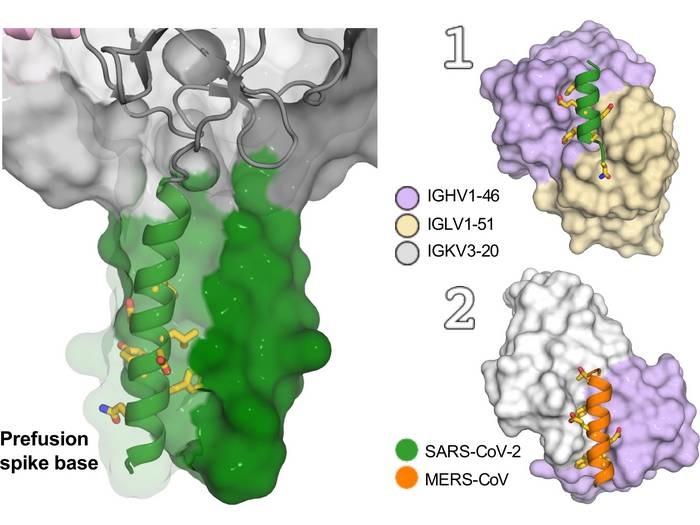
Detailed structural imagery of public bnAbs and where they bind to SARS-CoV-2 (green helix) and MERS-CoV (orange helix). These bnAbs recognize the S2 region of the viral spike protein, which is relatively conserved and could lead to the development of a broad coronavirus vaccine and related antibody therapies. Credit: Scripps Research
SARS-CoV-2 is one of several betacoronaviruses, a group of coronaviruses that also includes SARS-CoV-1 and MERS-CoV, and while innovations such as mRNA vaccines have aided in the management of the COVID-19 pandemic, additional strategies are needed to limit the impact of variants and prevent future coronavirus outbreaks. Current vaccines mainly target the S1 region of the SARS-CoV-2 spike protein, which is prone to mutation and differs from that of other betacoronaviruses. Researchers from Scripps Research Institute and the University of North Carolina have now discovered antibodies that can target the S2 region of the spike protein, more effectively blocking variants as well as SARS-CoV-2 and MERS-CoV.
The team previously reported the ability of some human antibodies to bind to the S2 region in a way that disrupts viral fusion and blocks COVID-19 infection. In the most recent study, the researchers sought to more comprehensively search for and characterize anti-S2 antibodies from human blood samples. The study involved three groups of human volunteers – those who have recovered from COVID-19 and have not been vaccinated, those who have not had COVID-19 and have been vaccinated, and those who recovered from COVID-19 and were subsequently vaccinated. The researchers discovered high levels of anti-S2 antibodies in the group who had both recovered and been vaccinated, which were found with much lower frequency in the other two groups.
The researchers identified and characterized a total of 32 human monoclonal antibodies targeting the S2 region. The antibodies were tested in virus neutralization studies and virus-challenge studies with mouse models, which revealed that several of the antibodies not only protected against SARS-CoV-2 and its variants, including Omicron, but were also effective against SARS-CoV-1 and MERS-CoV. Structural studies were also performed to characterize the common binding sites and modes of bindings of these antibodies, which the team dubbed pan-betacoronavirus broadly neutralizing antibodies (bnAbs). This research was recently published as a pre-proof in the journal Immunity.
“In principle, a vaccination strategy that can induce such antibodies is likely to provide broad protection against a diverse spectrum of betacoronaviruses,” said co-senior author Dennis Burton, a professor and chair of the Department of immunology and Microbiology at Scripps Research.
“Targeted rational vaccine strategies could take advantage of this molecular information of the interactions of these antibodies with the S2 domain to inform the design of pan-betacoronavirus vaccines,” said Ian Wilson, professor and chair of the Department of Integrative Structural and Computational Biology at Scripps Research.
The researchers have already applied their findings to the initial design and testing of a potential vaccine candidate, and also believe the bnAbs could be used to protect against new emerging betacoronaviruses, as well as to treat those who have already been infected with a virus.