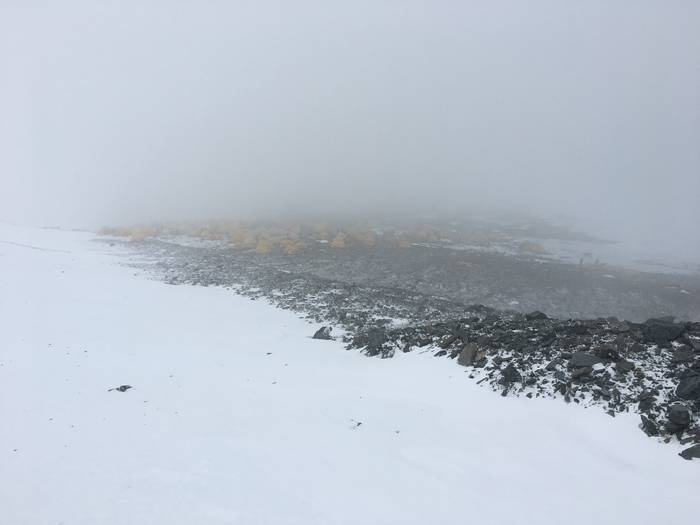
A camp on the South Col, where hundreds of adventurers pitch their final camp each year before attempting to scale the world’s tallest peak from the southeastern side. Photo taken near the site of where soil samples were collected by Baker Perry. Credit: Baker Perry
The possibility of life beyond Earth remains a hot topic in both research and popular culture, but life on our own planet’s most remote and extreme environments also remains a mystery to some degree. For example, while humans have journeyed to over 26,000 feet on Mount Everest since the early 20th century, the microbial diversity of this region has not been well-studied. Researchers at the University of Colorado at Boulder have used next-generation sequencing to study soil microbes from this elevation for the first time, revealing not only the extremophilic species present, but also the microbial footprint left behind by human mountaineers.
The soil samples were collected in May 2019 by researchers setting up the world’s highest weather station, established by National Geographic and the Rolex Perpetual Planet Everest Expedition. Co-author Baker Perry, a National Geographic Explorer and professor of geography at Appalachian State University, collected three surface sediment samples approximately 170 meters away from the researchers’ camp on the South Col of the mountain, about 7,944 m (~26,063 ft) above sea level. The UC Boulder researchers used cultivation-independent next-generation sequencing techniques to identify the organisms present in the samples, and performed bioinformatics analyses to explore the diversity of the microbial communities.
The results showed that the microbial diversity of the alpine soil samples was relatively low, with 31 bacterial families and 8 fungal families identified. The most abundant organisms were those of the fungal genus Naganishia, which is able to withstand extreme cold and UV radiation. However, the researchers were surprised to find DNA from two human-associated bacteria genera: Streptococcus and Staphylococcus. While these bacteria are not only found in humans, the sequences were further identified as coming from species closely associated with humans, such as S. hominis and S. epidermis, which are found on the skin, and S. oralis, which colonizes the mouth. These bacteria were not detected in extraction blanks and PCR controls, confirming that they likely originated from human activity on the mountain. This study was published in Arctic, Antarctic and Alpine Research.
“There is a human signature frozen in the microbiome of Everest, even at that elevation,” said senior author Steve Schmidt. “If somebody even blew their nose or coughed, that’s the kind of thing that might show up.”
While the human-associated bacteria found on Mount Everest would most likely be dormant and inactive in such extreme conditions, the ability to trace the microbial trail of human activity could have greater implications, including in the area of space exploration.
“We might find life on other planets and cold moons,” noted Schmidt. “We’ll have to be careful to make sure we’re not contaminating them with our own.”