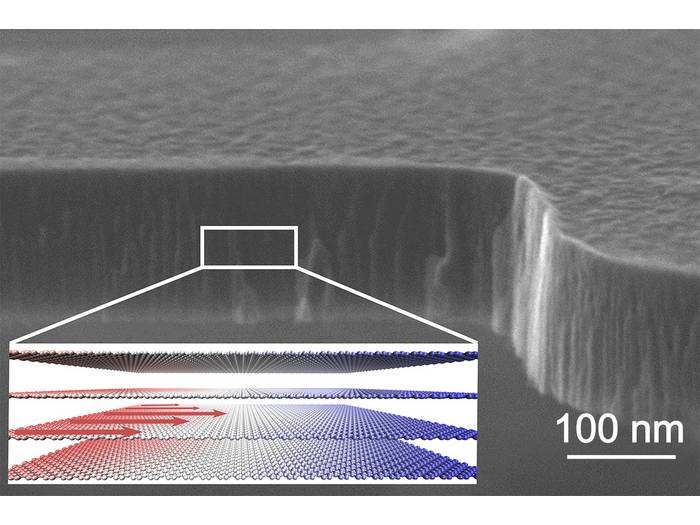
Researchers at the Institute of Industrial Science, The University of Tokyo use isotopically purified graphite to study the phenomenon of heat flowing like a fluid, which can lead to new heat-sink devices for electronics. Credit: Institute of Industrial Science, The University of Tokyo
Ordinarily, heat is transported throughout a solid material through random diffusion of phonons, which are vibrations of atoms or molecules that can be conceptualized as particles. In special conditions or materials, phonons can move more like a fluid, but detecting this type of heat conduction experimentally can be a challenge. Harnessing the fluid-like movement of heat could allow for more efficient heat removal in electronics such as smartphones and computers. Researchers at the University of Tokyo’s Institute of Industrial Science recently performed experiments using microscopic ribbons of isotopically pure graphite to study this phenomenon, and were able to characterize the fluid-like flow of heat through the material.
Natural graphite mostly consists of carbon-12 – the most abundant carbon isotope – but also contains about 1% of carbon-13 and other isotopes. These isotopic impurities impede the thermal conductivity of the material, so the researchers fabricated highly pure graphite ribbons containing 0.02% carbon-13 at most, which was confirmed by time-of-flight secondary ion mass spectrometry (TOF-SIMS). The thermal conductivity of the 5.5-μm-wide ribbons was observed using a non-contact, microsecond-scale time-domain thermoreflectance (μ-TDTR) technique, in which the material is heated by a pulsed laser and its reflectance is measured over time. The experiments were conducted at temperatures ranging from 10 K to 300 K, and the results from the purified ribbons were compared to those obtained from similar ribbons of natural graphite.
The experiments revealed evidence of the hydrodynamic flow of phonons throughout the purified graphite ribbons, a phenomenon known as phonon Poiseuille flow. The researchers found that heat conductivity in the purified graphite could reach more than double that seen in the natural graphite due to the difference in phonon behavior as influenced by its isotopic content. This enhancement in conductivity over natural graphite was observed between 50 K and 150 K, and was strongest at a temperature of about 90 K. The confinement of this effect to a specific temperature range further suggests that the fluid-like motion of the phonons was the reason for the increase in conductivity. Theoretical modeling of this mode of heat transport further supported the experimental results. This study was published in Nature Communications.
“In conventional Poiseuille flow, the velocity is highest near the center, which is what we propose happens with the phonons in our experiments,” said senior author Masahiro Nomura.
Phonon Poiseuille flow has previously been observed in other materials such as solid helium and black phosphorus, and theoretically, this phenomenon could also be possible at room temperature. The ability to better study and understand hydrodynamic heat flow could lead to better cooling mechanisms for computer processors and other sensitive devices.