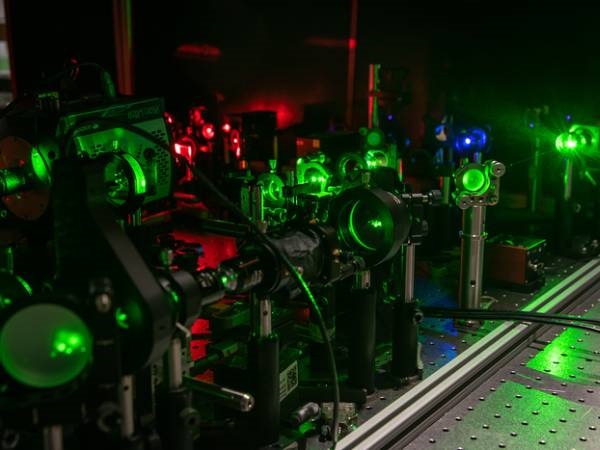
The quantum microscopy by coincidence (QMC) apparatus. Credit: Caltech
In conventional microscopy, resolution is limited based on the wavelength of light being used for imaging. Resolution can be increased by using a shorter wavelength, such as ultraviolet light or X-rays, but the tradeoff is that these shorter wavelengths carry higher energy, which can cause damage to samples such as cells. Researchers from the California Institute of Technology (Caltech) have turned to the phenomenon of quantum entanglement to improve resolution while minimizing destructiveness and built a new quantum microscope with twice the resolution of its conventional counterparts.
In quantum entanglement, the states of two particles are linked to each other regardless of the distance between the two particles. In the case of light, two quantum entangled photos are referred to as a biphoton, which has twice the momentum and half the wavelength of a single photon but carries a lower energy and thus is less destructive. The researchers dubbed their microscopy technique “quantum microscopy by coincidence” (QMC) and built a complex apparatus to generate and direct biphotons for imaging. The QMC system directs laser light through a β-barium borate crystal (BBO), which causes some of the photons passing through it to become entangled biphotons. The pair of entangled photons is then split and directed through separate, symmetrical paths using a series of mirrors, lenses and prisms, with one photon – the signal photon – passing through the sample and the other – the idler photon – not coming in contact with the sample. At the end of the path, the biphoton reaches an electron multiplying charge-coupled device (EMCCD) detector, and information from the signal photon is used to create an image of the sample.
The team used their QMC system to image samples including carbon fibers, a resolution test chart and HeLa cells. Using the resolution test chart, the researchers quantified the highest resolution of their QMC technique at 1.4 μm while the highest resolution achieved using a classical microscopy setup was 2.9 μm, representing a more than two-fold improvement in resolution using the quantum method. QMC images of HeLa cells revealed cellular structures that could not be resolved using classical imaging, demonstrating the technique’s potential value for nondestructive biological imaging. Additionally, the authors wrote that QMC was highly resistant to stray light, resisting stray light up to 155 times stronger than classical signals, while classical microscopy images showed severe disruption when stray light was 12 times stronger than the classical signal. This research was published in Nature Communications.
While the use of biphotons has previously been explored in the field of microscopy, the researchers note that their work presents a viable working system for quantum imaging.
“We developed what we believe a rigorous theory as well as a faster and more accurate entanglement-measurement method,” said corresponding author Lihong V. Wang. “We reached microscopic resolution and imaged cells.”
The authors note some limitations of QMC, such as the extremely low rate of entanglement achieved by BBO crystals. Due to the low efficiency of currently available quantum sources, QMC takes much longer to acquire an image compared with classical microscopy. The researchers believe that with potential future improvements in technology to generate quantum entangled photons, quantum microscopy methods will become more viable solutions to improve resolution and can even allow for more than two photons to be entangled at once, further enhancing the resolution.