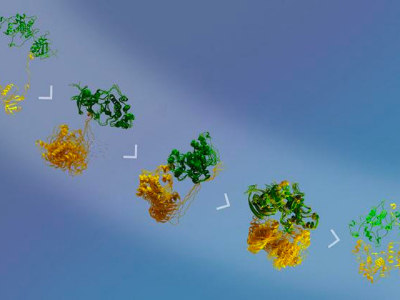
Signalling from inflammatory cytokines activates several protein kinases in a chain – at the end of this process MKK6 (yellow) ‘switches on’ p38α (green) by binding it and adding phosphates. Credit: Ella Marushchenko, Isabel Romero Calvo/EMBL
Researchers at EMBL Grenoble and University of Geneva have for the first time observed the structure of the MAPK p38α being activated by another regulatory protein. These findings pave the way for drug discovery to stop cytokine storms.
Cytokine storms can often lead to severe disease or even death if they spiral out of control. The new findings, published in Science, will play a critical role in allowing pharmaceutical manufacturers to develop new drugs to control these storms.
The inflammation response and release of cytokine is a multistep process that can originate from multiple ‘branches’ of the logic circuit, making p38a a key drug target as it is the convergent point for all inflammation signals. p38a is highly activated during a cytokine storm, thus inactivating it could prevent further issues from arising.
“These enzymes are very dynamic molecules; they transmit important signals and need to act quickly. In the case of p38α, it has to go into the nucleus and activate lots of other different proteins,” said Matthew Bowler, a researcher at EMBL Grenoble.
The researchers utilized cryo-electron microscopy (cryo-EM) along with small-angle X-ray scattering (SAXS) to study p38a and after some time, obtained the 3D structure and discovered a previously unknown docking site where p38a and MKK6 interact. “This could be an interesting target for inhibitors that block this specific interaction, and consequently the signal triggering the inflammatory response,” said Pauline Juyoux - PhD student and first author of the paper.
“The beauty of combining the state-of-the-art simulations with SAXS and cryo-EM data through advanced statistical approaches is that we can ‘see’ the dance of the two kinases approaching one another, while knowing that what we see in the computer is fully supported by all the experimental data available,” said Francesco Gervasio.
The findings will provide a potential drug target to be explored as well as paving the way for further research into similar MAP Kinases that cause diseases such as cancer or Alzheimer’s disease.
“Kinases are very similar to one another in terms of sequence and structure, but we don't know how and why they respond or send a specific signal,” said Juyoux. “Comparing these different families of kinases could help explain the specificity of interactions and lead the way to new therapeutic approaches.”