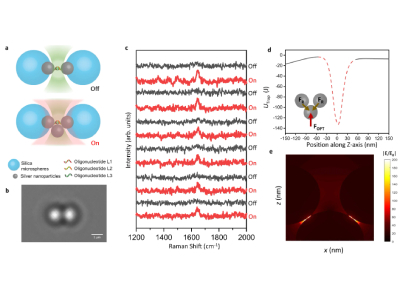
Dynamic nanocavity controlled by optical plasmonic trapping. Credit: Wenhao Fu et al.
Hong Kong University of Science and Technology (HKUST) researchers have developed an optical plasmonic tweezer-controlled Surface-Enhanced Raman Spectroscopy (SERS) system to detect various amylin species at the single-molecule level. The system has revealed the mechanisms of amyloid aggregation in type 2 diabetes.
In the study, published in Nature Communications, the method developed by the researchers allows for the reduction of detection volume and signal enhancement to provide efficient single-molecule characterization. This breakthrough provides a means to study pH-dependent amylin species in physiologically relevant concentrations.
"We present an easy-to-use strategy that reduces detection volume, enhances molecular signal, and increases turnover efficiency," said Huang Jinqing, Assistant Professor at HKUST's Department of Chemistry. "Our single-molecule platform can acquire a large amount of SERS spectra as molecular snapshots, comparable to those obtained through MD simulations. By statistically analyzing the structural details at the single-molecule level, we are able to reconstruct the bulk properties and gain unique insights into the population and probability of specific molecule types within the heterogeneous mixture. It has the potential to uncover hidden mysteries in complex systems."
The team constructed a plasmonic junction Ag nanoparticle-coated silica microbeads to trap an additional Ag nanoparticle to allow for the encapsulation of a single molecule within a dynamic nanocavity after laser irradiation. The resulting dimers show increased stability when compared to traditional Ag nanoparticles, making observation and location of the plasmonic junction more efficient and reproducible when using regular microscopes.
The findings will provide methods for type 2 diabetes researchers to understand the mechanisms responsible for pH-regulated amyloid aggregation. The physiologically relevant methods provided by the researchers provide insight that under previous ultra dilution and molecular immobilization techniques would not be possible.