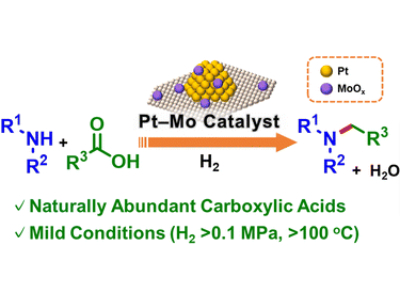
Credit: Katsumasa Sakoda et al.
A recent study led by Osaka University has developed a novel method for synthesizing alkylamines in a cost-effective yet sustainable way. Alkylamines are used for the production of countless everyday essentials ranging from pharmaceutical products to clothing.
In the study, published in Green Chemistry, the researchers developed a novel method for alkylamine synthesis that operated in mild conditions with water being the only byproduct. The method developed relies on the use of carboxylic acids, a product long avoided by the industry due to the difficult reaction conditions needed and the large amounts of byproducts produced.
Despite the challenges, the researchers developed a method that operates at relatively mild temperatures and pressures and requires only atmospheric hydrogen for the synthesis. "In our work, we unveil a novel catalyst system, a platinum—molybdenum catalyst, that can transform carboxylic acids into amines," said Katsumasa Sakoda, lead author of the study. "This produces alkylamines, which can be used for surfactants, pharmaceuticals and more."
Along with the mild reaction conditions, the method presented has numerous other advantages including a high turnover number, numerous compatible starting materials, high reaction yields, and the ability to reuse the catalyst at least five times.
"We're excited because our research improves the environmental sustainability and simplifies the experimental setup of a common class of chemical syntheses," said Tomoo Mizugaki, senior author of the study. "We hope that this is only the first step toward the development of greener catalyst processes."
The research is a critical step towards increasing chemical reaction sustainability industry-wide, and thanks to the simple procedures the method could likely be applied to numerous other catalytic processes.