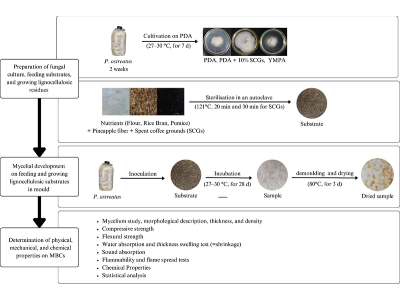
The diagram illustrating the bio-fabrication process for composites based on mycelium from Pleurotus ostreatus. Credit: Chatchai Kohphaisansombat et al.
A collaborative team of researchers has developed a novel biodegradable material called "mycelium-based composites (MBCs)" that can repurpose waste products while creating an eco-friendly material. Unlike traditional synthetic materials, MBCs break down into natural substances at the end of their lifecycle, reducing waste and lowering their environmental impact.
In the study, published in Mycology, the researchers demonstrate the highly versatile physical properties of MBCs. Their strength and density can be tailored to specific applications from packaging materials to building materials. The flexibility of MBCs is one of their key advantages, providing potential applications in several different industries.
MBCs are manufactured utilizing fungal mycelium and in certain applications can be enriched with pineapple fibers to alter its physical properties. To harvest the mycelium researchers optimized a spent coffee ground and natural pineapple fiber mixture to create a suitable substrate for the growth and culture of Pleurotus ostreatus (oyster mushroom).
The researchers discovered that the proportion of pineapple fibers in the material can directly impact properties such as strength or water resistance. Further analysis demonstrated that MBCs reinforced with a 10% pineapple fiber mixture showed the highest overall strength and density, while those reinforced with 30% pineapple fibers showed increased bending strength, water absorption, and sound absorption.
Renowned in several industries thanks to their unique properties, MBCs are an increasingly popular option in industries where sustainability and environmental impact are key considerations.