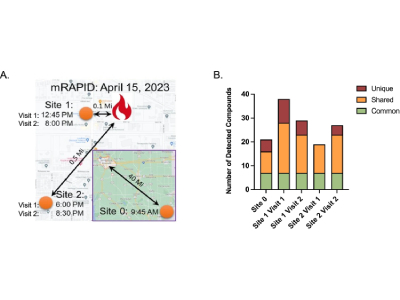
Stationary air monitoring detects sampling site-specific emissions. Credit: Eva C. M. Vitucci et al.
A team of researchers from Texas A&M University has developed a high-resolution mass spectrometry method to analyze air-borne contaminants resulting from natural or man-made disasters. The PTR-MS based method provides a highly accurate means of analysis to determine the molecule compounds within an air sample.
In their research, published in the Journal of Exposure Science & Environmental Epidemiology, the researchers used the high-resolution mass spec method to identify the molecular compounds in the air following a major fire at a local plastic recycling facility in Richmond, Indiana. The fire led to the evacuation of residents within a half-mile radius and debris was found as far away as 30 miles from the facility.
"The Environmental Protection Agency does extensive, long-term recovery work after disasters like this," said Natalie Johnson, from the Department of Environmental & Occupational Health. "We believe that our study proves this method produces accurate data very quickly, which could help officials determine the best evacuation zones following a disaster."
Following the fire, the team monitored the air within and around the half-mile evacuation zone using non-targeted analysis. By using non-targeted analysis the researchers could quickly and accurately identify all of the compounds, saving time and resources when compared to traditional methods. While this approach has shown promise in tests, this was the first time it was used in a real-world disaster.
The method could become an invaluable tool for identifying and assessing contaminates resulting from major disasters. While monitoring after the recycling facility fire, the researchers identified 46 VOCs in the area, of which nearly 45% are classified as high hazards.
"Each of the VOC levels we detected were individually below the hazard thresholds for single exposures, but we currently do not fully understand what the hazard thresholds would be for exposure to VOC mixtures such as these," Johnson added.
"Fires at recycling plants and other typically smaller-scale disasters are usually overlooked as contributors to pollution levels, but they also are happening more frequently across the United States. This makes research and the application of research findings a pressing public health issue."