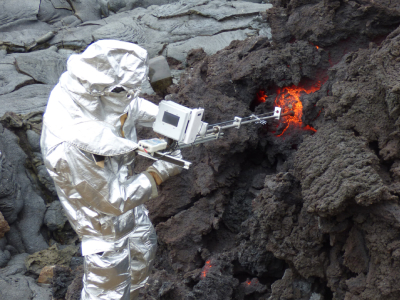
In a field test of their instrument, University at Buffalo researchers gathered viscosity data from lava flows at the Litli-Hrútur eruption in Iceland. Credit: Martin Harris
Researchers from the University at Buffalo have developed a novel instrument to measure the viscosity of lava. Lava viscosity is a critical measurement utilized by local authorities when issuing guidance to protect personal property and human lives.
For many fluids such as lava, viscosity measures how fast the fluid moves. After volcanic eruptions, viscosity guides first responders and provides crucial information about the response times necessary. Despite the critical importance of these measurements, current measurement methods are inadequate and are often conducted within a laboratory.
"When lava erupts from a volcano, a lot of different gases are trapped as bubbles within the lava," said author Martin Harris. "When we do measurements in the lab, we cannot put the gas back in. So, what we measure is a representation of the lava without all the different components, and we miss something that influences how the lava can flow."
To develop the instrument, the team employed the traditional approach of using metal rods but expanded on the concept to include a force gauge to ensure accurate measurements and a secondary rod used to measure displacement. The overall design is lightweight enough to offer handheld field use and durable enough to withstand volcanic environments.
During field trials of the new instrument, the team collected dozens of measurements at different locations and times at the Litli-Hrútur eruption in Iceland. The data collected is crucial in understanding eruptions and lava flows as it shows how lava flows can evolve as they spread and cool.
"It was the first time that people have done these measurements across these different transects of the lavas," said Harris. "The really exciting thing about this instrument is that we were able to show this change in the physical properties of the lava with time and space."
The team intends to refine the design, with the ultimate goal of providing the instrument to research groups and volcano monitoring stations worldwide.