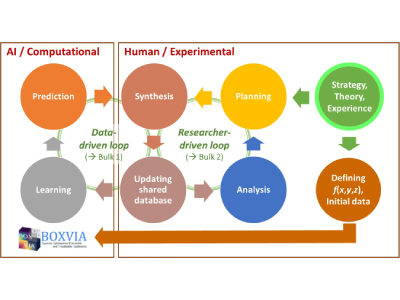
Conceptual schematic of the complementary data- and researcher-driven process designs. Credit: Akiyasu Yamamoto et al.
Scientists have created the world's strongest superconducting magnet with the assistance of AI. superconducting magnets are used in a range of applications including medical imaging and transportation.
Currently, most superconductors are constructed from large coils of superconducting niobium-tin alloy wire. While this design is effective, applications within various devices are limited by their large size. In a paper, published in NPG Asia Materials, researchers have developed a cost-effective iron-based superconducting magnet by leveraging the power of machine learning.
"Superconducting magnets are the backbone of the future. Not only are they used to image cancers with MRI machines, but they will be vital for electric aircraft and nuclear fusion," said Mark Ainslie from the King's College London Department of Engineering. "Using artificial intelligence (AI), we've produced a cost-effective and scalable alternative using iron, which is a lot easier to work with and opens the door for smaller and lighter weight devices. The first iron-based superconductors were made over 10 years ago, but the magnetic fields they produced were nowhere near strong or stable enough for widespread use."
By using a machine learning system, called BOXVIA, the researchers were able to optimize superconductor creation faster than previously possible. BOXVIA can spot patterns to aid in performance improvements and optimization. Additionally, during development, the team discovered that superconducting magnets produced with BOXVIA had different microscopic structures than those produced through conventional methods.
The team intends to further their research by investigating how this never-before-seen nanostructure contributes to the improved properties of the magnet. By understanding and manipulating these nanostructures, the team believes even more powerful magnets can be produced.