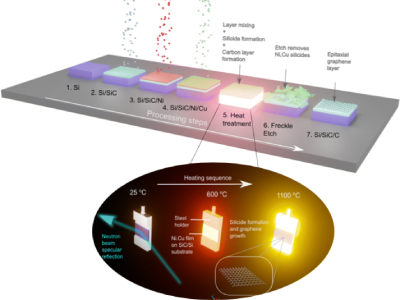
Schematic of the Ni/Cu catalytic alloy-mediated EG synthesis on 3C–SiC on silicon. Credit: Aiswarya Pradeepkumar et al.
Researchers from ANSTO and the University of Technology Sydney have set a new record by conducting thin film research at a staggering 1,100 degrees Celsius. The research is relevant to countless thin film technologies that undergo an array of processing and heat treatment to optimize their performance.
In the research, published in RSC Advances, the group sought to better understand the growth mechanisms of graphene on SiC/Si substrates. To accomplish this, the team utilized the Spatz neutron reflectometer at the Australian Center for Neutron Scattering. Thanks to the unique characteristics of neutrons, the films can be studied in situ, and in the researcher's particular case analysis occurred within a vacuum furnace which allowed the researchers to observe film changes by the minute.
"The unique high-temperature neutron reflectometry has allowed us to gain insights into the alloy-mediated epitaxial graphene synthesis on 3C-SiC/Si substrates unveiling novel avenues of 2D material optimization for nanoelectronic and nanophotonic applications," said Aiswarya Pradeepkumar.
To accomplish the work, the furnace needed to be integrated with the Spatz, and specialized sample holders were created. Additionally, the large sample area of the Spaztz instrument allows for a range of large sample environments. To date, the research conducted was the highest temperature achieved while studying thin films with reflectometry.
"I am really excited by the new opportunities for high temperature reflectometry work," said David Cortie, an ANSTO scientist.
"This capacity will allow a range of important thin film processes to be studied with neutron reflectometry for the first time, to reveal nanoscale insights that are hidden from many other probes. There are already a number of related thin film studies underway at the Australian Center for Neutron Scattering."