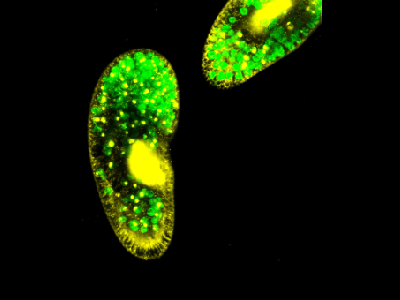
Fluorescence microscopy image of Paramecium bursaria showing Chlorella spp. algal symbionts in green. Credit: Dr. Ben Makin
Scientists at the University of Exeter have discovered that warming temperatures could cause symbiotic relationships to fail in the environment.
The research, published in Aquatic Biology, investigated Paramecium bursaria a single cell organism that can absorb and host algae. This relationship is a common symbiotic relationship in freshwater ecosystems around the world. Despite their typical symbiotic relationship, researchers found that when the water was made only 5°C warmer, the relationship failed causing the algae to become parasitic.
This kind of relationship—called photosymbiosis—is an important part of freshwater and ocean ecosystems," said Dr. Ben Makin, of the Environment and Sustainability Institute on Exeter's Penryn Campus. "To illustrate their importance, these relationships provide around half of all marine photosynthesis. A well-known example is found in coral reefs—where the reef-building corals host resident photosynthetic partners. In recent years, we have seen many high-profile 'bleaching' events—when corals expel these partners, often due to high temperatures, leaving them at risk of stress and mortality."
During their research, the team kept Paramecium bursaria and Chlorella spp. at different temperatures representing cooling (20°C), warming (30°C), and the control at 25°C.
"With 5°C of warming—consistent with worst-case climate scenarios by the end of this century—the relationship between these species appears to be fundamentally changed," Dr. Makin said.
While some species may evolve to “rescue” themselves, doing so quickly enough to keep up with environmental changes may prove challenging. "Warming has the power to erode these relationships over evolutionary timescales—with serious implications for global, highly productive photosymbiotic associations, like those found in coral reefs," said Dr. Makin