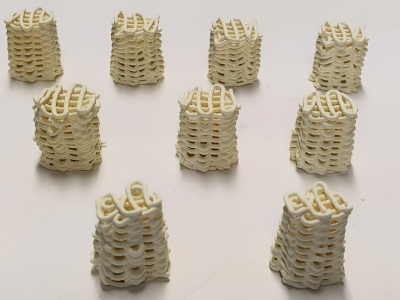
3D printed ceramic lattices have been proven to remove harmful 'forever chemicals' from water. Credit: University of Bath
University of Bath researchers have developed a new way to remove harmful PFAS from water utilizing 3D printing technology. During analysis, the method removed 75% of PFOA in water samples.
Published in Chemical Engineering Journal, the method utilizes ceramic indium oxide infused ink to extrude and create 3D-printed monoliths. Thanks to the strong bonds indium forms with PFAS, PFAS immediately sticks to the printed monoliths and can be removed from water in less than three hours. The researchers point out that this three hour timeline is compatible with current treatment plants in both the UK and abroad.
"Using 3D printing to create the monoliths is relatively simple, and it also means the process should be scalable. 3D printing allows us to create objects with a high surface area, which is key to the process. Once the monoliths are ready, you simply drop them into the water and let them do their work. It's very exciting and something we are keen to develop further and see in use," said Dr. Liana Zoumpouli, a Research Associate in Bath's Department of Chemical Engineering.
Current data demonstrates that the 3D printed monoliths remove 75% of PFAS in water, however the researchers are aiming to increase the efficiency through process improvements.