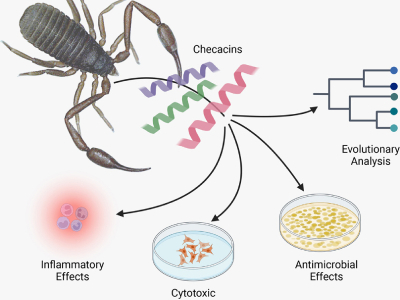
Credit: Pelin Erkoc et al.
German researchers have discovered that the venom of book scorpions has a strong effect on hospital germs. The results of their study could aid in combatting drug-resistant infectious diseases found within hospitals.
Book scorpions are a member of the pseudoscorpions found in central Europe and primarily predate on mites and lice. In the study, published in iScience, researchers comprehensively characterized the book scorpions venom for the first time.
During their work, the researchers artificially produced and investigated the activity of book scorpion toxin. Ultimately, it was discovered that the venom demonstrated strong activating against methicillin-resistant Staphylococcus aureus (MRSA), a well-known hospital germ.
The family of toxins the researchers analyzed are named “checacins” and were previously discovered while researching book scorpions. While the data is promising, the researchers note that more work will need to be conducted before a pharmacological application is possible.
"Our data show that the checacins unfortunately also have a certain toxicity for human cells and could possibly cause inflammatory reactions themselves. Therefore, we still need to optimize their structure and thus their effect using biotechnological processes, as is the case with other active substances," said Dr. Pelin Erkoc, TBG scientist , who worked at the Institute of Pharmaceutical Biology at Goethe University Frankfurt during the analyses.
"Animal venoms are a veritable treasure trove of potential drug candidates, but only a small proportion have been investigated so far," added Dr. Tim Lüddecke, head of the junior research group Animal Venomics at Fraunhofer IME-BR "Our new results on the checacins show how worthwhile it is to take a closer look at the unknown universe of venoms of small creepy-crawlies."