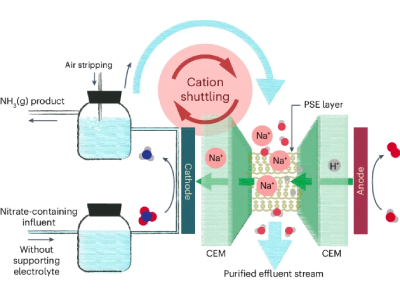
Credit: Feng-Yang Chen et al.
Engineers from Rice University have developed a revolutionary reactor that could be used to produce ammonia while reducing energy consumption and CO2 emissions. The reactor technology could also be adapted to other chemical processes, helping future researchers achieve net-zero goals.
While ammonia is critical for food production, producing it accounts for nearly 2% of global energy consumption and 1.4% of CO2 emissions. To combat this, Rice University engineers developed a revolutionary reactor that converts nitrates into ammonia.
In the research, published in Nature Catalysis, the team of engineers developed a novel technique using electrochemical synthesis to drive the reaction.
"Electrochemistry can occur at room temperature, is more amenable to scalable formats for different infrastructure systems, and has the capacity to be powered by decentralized renewable energy," said Feng-Yang Chen, a Rice graduate student who is the lead author on the study.
The new design developed by the researchers makes a nitrate-to-ammonia conversion pathway possible and eliminates the need for denitrification. This nitrate conversion offers a greener ammonia production method and a water contamination remediation method that does not require traditional denitrification or the Haber-Bosch process.
"We discovered that our novel reactor system could turn nitrate-contaminated water into pure ammonia and clean water very efficiently, without the need for extra chemicals. In simple terms, you put wastewater in, and you get pure ammonia and purified water out."
"Nitrate is one of the priority pollutants that most frequently violates drinking water standards, and it is a significant concern in growing cities as farmland with nitrate-contaminated groundwater supplies is converted to urban development," said Pedro Alvarez, Professor of Civil and Environmental Engineering at Rice.
"Our findings suggest a new, greener method of addressing both water pollution and ammonia production, which could influence how industries and communities handle these challenges," said Wang, associate professor of chemical and biomolecular engineering, materials science and nanoengineering, and chemistry at Rice. "If we want to decarbonize the grid and reach net-zero goals by 2050, there is an urgent need to develop alternative ways to produce ammonia sustainably."