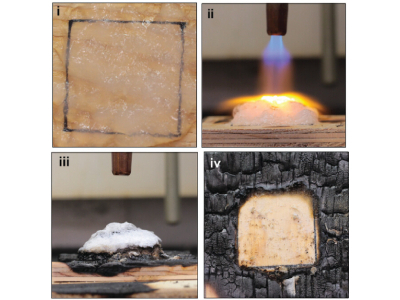
Images of i) applying fire gel onto wood substrate, ii) burning the gel with a fire torch, iii) forming silica aerogel, iv) revealing the intact, uncharred wood under the silica aerogel protective layer. Credit: Changxin Dong et al.
Stanford researchers have developed a novel water-enhancing gel that can be sprayed on homes and other infrastructure to protect them during wildfires.
In the study, published in Advanced Materials, the researchers described their novel gel as well as demonstrated its improved efficacy when compared to commercially available gels.
"Under typical wildfire conditions, current water-enhancing gels dry out in 45 minutes," said Eric Appel, associate professor of materials science and engineering in the School of Engineering. "We've developed a gel that would have a broader application window—you can spray it further in advance of the fire and still get the benefit of the protection—and it will work better when the fire comes."
Water-enhancing gels are made with super-absorbent polymers that when mixed with water and sprayed onto a surface swell into a gelatinous substance to shield them from fire. However, in areas impacted by wildfires extreme temperatures and wind often evaporate the water locked in gels rather quickly. To combat this, the team used silica particles in combination with the cellulose-based polymer which are left behind once the gels are exposed to heat.
"We have discovered a unique phenomenon where a soft, squishy hydrogel seamlessly transitions into a robust aerogel shield under heat, offering enhanced and long-lasting wildfire protection. This environmentally conscious breakthrough surpasses current commercial solutions, offering a superior and scalable defense against wildfires," said Changxin "Lyla" Dong, lead author of the study.
"When the water boils off and all of the cellulose burns off, we're left with the silica particles assembled into a foam," Appel said. "That foam is highly insulative and ends up scattering all of the heat, completely protecting the substrate underneath it."
The researchers intend to pilot the gels in small-scale testing to further optimize them. "They're safe for both people and the environment," Appel said. "There may need to be additional optimization, but my hope is that we can do pilot-scale application and evaluation of these gels so we can use them to help protect critical infrastructure when a fire comes through."