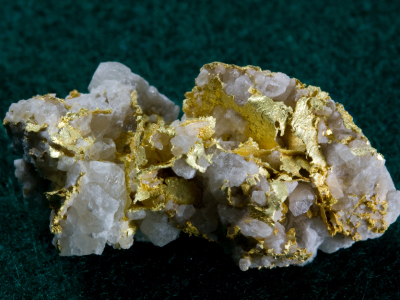
Geologists from Monash University have discovered that piezoelectricity caused by earthquakes could be what forms gold nuggets.
"The standard explanation is that gold precipitates from hot, water-rich fluids as they flow through cracks in the Earth's crust," said Dr. Chris Voisey from the Monash University School of Earth Atmosphere and Environment. "As these fluids cool or undergo chemical changes, gold separates out and becomes trapped in quartz veins. While this theory is widely accepted, it doesn't fully explain the formation of large gold nuggets, especially considering that the concentration of gold in these fluids is extremely low."
In the research, published in Nature Geoscience, the team tested the theory that the piezoelectricity is what forms these rare nuggets. Piezoelectricity is a unique property of quartz, the mineral that typically hosts gold nuggets, in which an electric charge is generated when the quartz is stressed.
To test their hypothesis, the team submerged quartz crystals in a gold-rich fluid and used a motor to simulate the shaking caused by an earthquake to stress the crystals.
"The results were stunning," said study co-author Professor Andy Tomkins, from the Monash University School of Earth, Atmosphere and Environment. "The stressed quartz not only electrochemically deposited gold onto its surface, but it also formed and accumulated gold nanoparticles. Remarkably, the gold had a tendency to deposit on existing gold grains rather than forming new ones."
"Our discovery provides a plausible explanation for the formation of large gold nuggets in quartz veins," said Voisey. "In essence, the quartz acts like a natural battery, with gold as the electrode, slowly accumulating more gold with each seismic event."