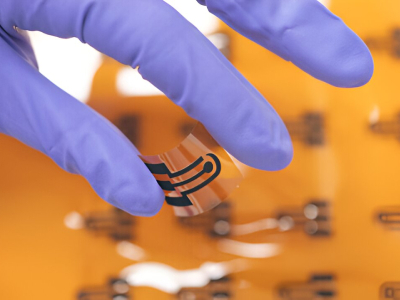
Credit: University of Hawaii at Manoa
University of Hawaiʻi at Mānoa researchers have developed a novel technique to develop wearable health sensors in a more accessible and affordable manner.
Wearable health sensors provide real-time monitoring of critical health metrics and vital signs that enable personalized medical care. However, their production often requires highly specialized facilities which limits their widespread application.
In the research, published in Biosensors and Bioelectronics, the researchers present a low-cost stencil-based method to produce these sensors using laser-induced graphene, or LIG.
"This advancement allows us to create high-performance wearable sensors with greater precision and at a lower cost," said Tyler Ray, Assistant Professor in the Department of Mechanical Engineering. "By using a simple metal stencil during the laser patterning process, we've overcome a key limitation of the traditional fabrication process, which opens up new possibilities for sensor design and functionality."
By utilizing commercially available stencils, the team reduced the minimum feature size of the sensor from 120 micrometers to 45 micrometers. This reduction will allow for the development of more complex sensors which were previously difficult to achieve with laser processing.
"We demonstrated the practicality of our method by fabricating temperature sensors and multi-electrode electrochemical sensors," Ray explained. "These devices exhibited enhanced performance, which we attribute to the improved resolution and quality of the graphene patterns."
The LIG method will enhance the accessibility of health monitoring tech by allowing for their production without the reliance on the resource-intensive fabrication methods commonly employed.