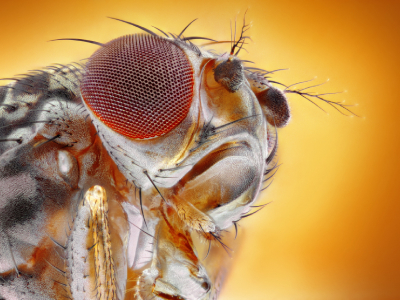
Neuroscientists have successfully reconstructed the entire anterior visual pathway of a fruit fly unveiling a complex network of connections between the eye and the navigation center of the brain.
In the research published in Nature, UC Santa Barbara neuroscientists employed artificial intelligence to resolve the relationship of more than 3000 neurons in unprecedented detail. Published as part of a suite of nine papers, the work accounts for the largest and most complex brain to be thoroughly mapped. The research brings us ever closer to understanding the intricacies of animal brains.
"In systems neuroscience, the question is how neurons interact and generate perception, cognition, motor commands and so on," said Kim, a co-author of two studies appearing in the journal Nature. "But the major problem here is that we don't know how the neurons are connected to each other. So it's difficult to understand what's really going on in the neural network."
The team found that in fruit fly brains, 50 "compass neurons" are responsible for encoding the fly's sense of direction. Researchers commonly use fruit fly brains as a model to resolve complex neural circuitry. "It's a lot easier to look at these pathways in the fly's brain," said co-lead author Dustin Garner.
To experimentally confirm many of the team predictions, a virtual reality arena was developed that was highly controllable and utilized UV to amber light to apply stimuli to a tethered fly. Once stimuli were applied, the team monitored the fly's brain activity with a particular focus on which neurons would fire based on what was presented to the fly's visual system.
The detailed data derived from the experiments can be used to build computational models to resolve how animals navigate. These models could additionally find applications in many sectors, including serving as a model for self-driving cars without the need for a GPS.