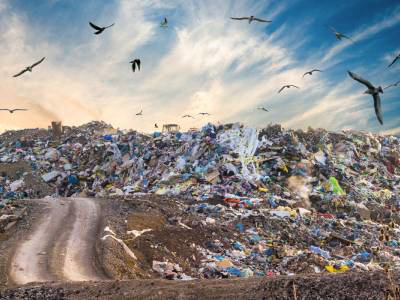
To better understand how plastic and per- and polyfluoroalkyl substances move through landfills, researchers analyzed the leachate of four Illinois landfills as well as the inflow and outflows at their associated water treatment facilities.
In the study, published in Science of The Total Environment, the team determined that landfills retain most of the plastic waste. Additionally, wastewater treatment facilities removed 99% of microplastics and some of the PFAS from the wastewater and leachate. Despite these successes, the team did discover that both PFAS and microplastics accumulate in the wastewater treatment facilities biosolids, which are disposed of in other ways.
According to an industry-funded data project, 70% of Illinois wastewater biosolids are used as fertilizer on agricultural land with the remaining 30% being buried in landfills. “The wastewater treatment plants are just taking the contaminants from one media and putting it into another,” said John Scott, a research scientist at the Illinois Sustainable Technology Center at the University of Illinois Urbana-Champaign.
While studies on wastewater leachate and landfills have been conducted in the past, the research conducted by the team offered a unique perspective by combining landfill leachate along with wastewater influent and effluent into one study. Additionally, most studies on the topic simply measure microplastic particles per volume of liquid, the team opted for a more accurate surface area measurement while considering plastic particle density.
“Landfills and wastewater treatment plants are usually studied separately, but in reality, those are combined systems,” said ISTC research scientist Andres Prada. “Regulations require that landfills send their liquid waste to the treatment plants.”
PFAS and microplastic contamination of wastewater biosolids present a unique remediation challenge. Scott noted that spreading these contaminants over croplands is not good practice. “But what else are we to do with it? If we landfill it, we’re just going around and around in the circle of moving it from landfill to wastewater treatment plant and back to the landfill.”
Considering the future, Scott believes that the best practice is to prevent upstream sources of contamination. “It’s time to tell people to start moving away from these things, stop producing these things,” he added. “Let’s turn them off at the tap before this gets any worse.”