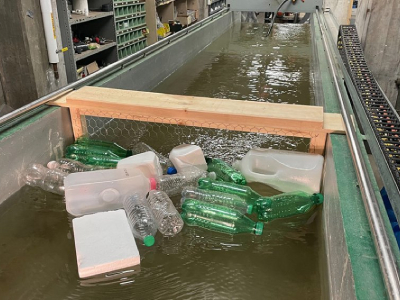
A new study looks at how remote sensing could help monitor and remove plastic debris from freshwater lakes and rivers. Credit: Mohammadali Olyaei, University of Minnesota Twin Cities
University of Minnesota Twin Cities researchers have conducted a first of its kind study demonstrating the efficacy of remote sensing to monitor and remove plastic from aquatic environments.
While plastic pollution in the ocean is often at the forefront of environmental discussions, plastic pollution in freshwater environments such as lakes and rivers has garnered less attention. Since most of the plastic that ends up in the ocean arrives there via rivers, the University of Minnesota researchers set out to develop a cost- and labor-effective strategy for removing plastic pollution from freshwater environments.
To aid in their goal, the team relied on remote sensing technologies which allow for a more cost-effective solution while also reaching a larger area. To differentiate plastic from naturally occurring materials such as seaweed or driftwood, the team utilized the spectral reflectance properties to pinpoint plastic.
“We could use this technology to identify different types of plastics in the water simultaneously. This is key information that we need when employing other technology, like drones, to capture and remove plastic debris in natural environments,” said Mohammadali Olyaei, a Ph.D. student in the Department of Civil, Environmental, and Geo- Engineering.
In their work, published in Scientific Data, the team tested the device using the real-world conditions of the Mississippi river at the St. Anthony Falls Laboratory. During their study the team used a spectroradiometer combined with a single lens DSLR camera to monitor and classify types of debris.
“If we can develop technology at the Mississippi headwaters, in a place like Minnesota, to catch plastic debris, we can protect the downstream states and the entire ocean from plastic pollution. As soon as these plastics begin to spread more and more, their control becomes more and more challenging,” said Ardeshir Ebtehaj, Associate Professor in the Department of Civil, Environmental, and Geo- Engineering.
The researchers hope to continue their work on a larger scale to better understand where plastic debris comes from and how it moves through a river system.