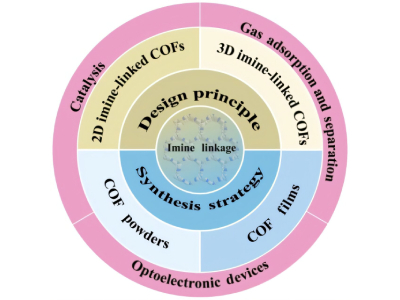
A recent study from the University of Science and Technology Beijing is shining a spotlight on imine-linked covalent organic frameworks (COFs), a novel porous material that is set to revolutionize countless industries ranging from gas capture to next generation electronics.
Despite their promise, porous materials have yet to experience widespread adaptation as their precise manufacturing remains a significant challenge. Given these manufacturing challenges, imine-linked COFs stand out as a potential new frontier in porous material manufacturing thanks to their ease of synthesis and structural versatility.
In their study, published in the journal SmartMat, the team of researchers provide an in depth exploration of the current design, synthesis, and applications of imine-linked COFs. Additionally, their study offers a comprehensive review of recent advancements in imine-linked COF synthesis and sheds light on their broad potential. The team also explores novel strategies for topology design and reveals how imine linkages influence the physicochemical properties of COF powder and film frameworks.
"Imine-linked COFs represent a paradigm shift in the design of porous materials," says Professor Liping Wang, one of the study's senior researchers. "Their unique properties, combined with the ability to fine-tune their structure, offer unprecedented opportunities across diverse applications, from environmental solutions to next-generation electronics."