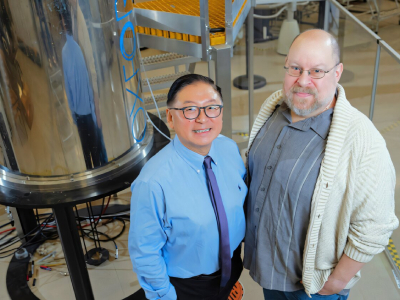
Bin Yang, professor in WSU's Department of Biological Systems Engineering, stands with Andrew Lipton, scientist at Pacific Northwest National Laboratory, next to a nuclear magnetic resonance instrument used in experiments on new sustainable fuels. Credit: by Andrea Starr and Eddie Pablo | Pacific Northwest National Laboratory
New research has led to the development of a novel method to store and release volatile hydrogen with a new lignin-based jet fuel, a method which could create new pathways for sustainable energy production.
The research, which is published in the International Journal of Hydrogen Energy, demonstrates that the new type of lignin-based jet fuel they developed can chemically bind hydrogen in a stable liquid form. With countless potential applications in the fuel and transportation sector, the method could simplify harnessing hydrogens potential as a zero-emission high energy fuel source.
"This new, lignin jet fuel-based technology could enable efficient, high-density hydrogen storage in an easy-to-handle sustainable aviation fuel, eliminating the need for pressurized tanks for storage and transport," said Washington State University Professor Bin Yang.
While hydrogen has long been of interest as a potential energy source, its explosive nature and low density make storage and transportation difficult and expensive. To remedy this, the team developed the novel storage process which relies on the chemical reactions that produce aromatic carbons and hydrogen from the lignin jet fuel.
"This innovation offers promising opportunities for compatibility with existing infrastructure and economic viability for scalable production," Yang said. "It could help create a synergistic system that enhances the efficiency, safety, and ecological benefits of both sustainable aviation fuel and hydrogen technologies."
Next steps for the team include developing an AI-driven catalysts to improve the reaction efficiency to make the whole system more cost-effective.