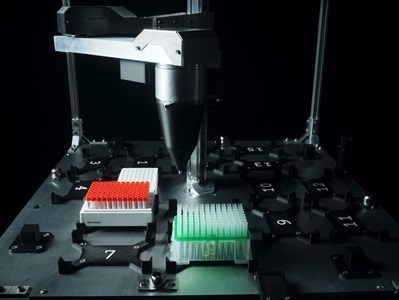
Trilobio introduced the first version of its comprehensive robotics, lab equipment and software platform at the Society for Laboratory Automation and Screening conference, alongside pilot customer data, demonstrating the platform’s abilities in advancing research workflows.
The Trilobio platform comprises the Trilobot lab robot, research devices (gripper, pipettes, and tube handlers), and the Trilobio OS research protocol software. It is purpose-built to ensure all research protocols designed and executed on the platform are reproducible in any other Trilobio-enabled lab. By facilitating whole lab operations to be automated, the company’s mission is to support biologists to maximize the potential of their research easily, accurately, and reliably. A key focus is overcoming the cost, complexity, configuration and training hurdles that prevent scientists from adopting automation more broadly.
Trilobio was founded to improve genetic engineering, synthetic biology and life science research processes by building robotic lab automation modules coupled with an application store to package and distribute lab protocols as code. The company is deploying fully automated labs that address data quality and reproducibility challenges to improve research inefficiencies, whereby it is estimated that 77% of biologists cannot reproduce their own or other’s research, despite latest advances in laboratory automation tools.
The Trilobio platform is already deployed at leading biology labs and has generated validating data from initial pilot programs. including at the Leconte Group, a genetic engineering academic lab at the Keck Science Department of the Claremont Colleges, Abalone Bio, a synthetic biology company developing novel antibodies for challenging disease targets, and Triton Bio, a biotechnology company providing novel bioinstruments.