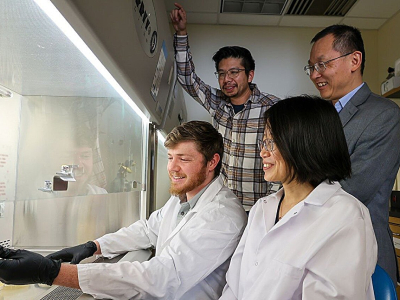
From top left: Biologist Bryan Hsu with immunologist Liwu Li. Bottom left: Zachary Baker, a doctoral student in the Hsu Lab, and research assistant professor Yao Zhang from the Li Lab. Credit: Spencer Coppage for Virginia Tech
A recent study from Virginia Tech researchers has demonstrated how gut bacteria could be directed to produce and release proteins within the lower GI tract. This production and release of proteins could help eliminate a major drug delivery roadblock to that region of the body.
Their work, which is published in Nature Biotechnology, relies on an unprecedented workaround which involves engineering bacteriophages to infect and reprogram bacterial cells to release a sustained flow of protein-based drugs.
Phages operate in the gut microbiome by attaching to a bacterial cell and injecting its own DNA to reprogram the cell to manufacture more phages. Exploiting this cycle allowed the researchers to reprogram bacterial cells to produce a constant supply of target proteins in the lower intestine.
To prove the technique, the researchers successfully engineered phages to tackle symptoms associated with two different diseases in mice. In one round of testing, the phages reduced the inflammation associated with inflammatory bowel disease by releasing a protein which inhibited an enzyme associated with the disease. In the other, obesity was reduced by releasing a protein to induce a feeling of satiety in mice consuming a high fat diet.
With the positive results the team is now set to explore commercialization of the technique through the National Science Foundation I-Corps program and the Fralin Commercialization Fellowship. Additionally, although they have proven a drug can be delivered, the team will now focus on how to get that drug into systemic circulation.
"It's like we're Amazon. We got the stuff there, we dropped it off on the doorstep," said Bryan Hsu, Assistant Professor of Biological Sciences at Virginia Tech. "Now we need to figure out how to ring the doorbell."