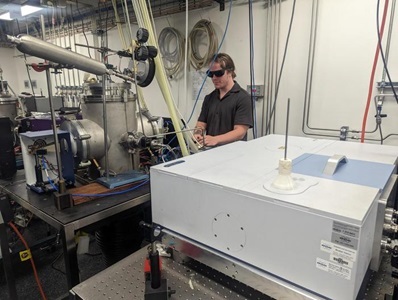
The team produced a gas mixture at various pressures to simulate the atmosphere. Joshua Thompson, a PhD student involved in the research, operates the technology. Credit: UNSW
A team of scientists at the University of New South Wales has discovered that some replacement refrigerants still break down into persistent greenhouse gas pollutants, including compounds that have been banned internationally.
Hydrofluoroolefins (HFOs) are the lead synthetic chemical for refrigerants, and are considered a more environmentally friendly alternative to their chemical predecessors. However, a new study published in the Journal of the American Chemical Society, has demonstrated that HFOs break down into a small amount of fluoroform. This new research suggests the need to more closely examine HFOs’ environmental impact, raising questions about their long-term safety.
Researchers used multiple techniques, including two invented just for this study, to measure and evaluate the chemical reaction across the full range of pressures expected in the atmosphere.
“We used a variety of spectroscopic techniques to observe the reaction and we made up a gas mixture at various pressures to simulate an atmosphere polluted with a trace amount of the immediate HFO decomposition product. Then, we used a laser to simulate the photons that would otherwise come from the sun, to drive the reaction,” said study author Christopher Hansen from UNSW Chemistry.
We know that HFOs decompose into fluorinated carbonyls such as trifluoroacetaldehyde at a yield up to or greater than 100%. This means all the molecules of HFO turn into the first product and, for some HFOs, you might get two molecules of that product for each molecule of HFO that breaks down. This study revealed that the next step of the reaction, driven by light, produces a small amount of fluoroform from the decomposition of trifluoroacetaldehyde. Fluoroform is the HFC with the greatest global warming potential.
“We have demonstrated comprehensively that some of the most important HFOs do break down into HFCs and have provided the first hard scientific data needed to model and predict the consequences of large-scale emission,” said Hansen. “Although the reaction only produces a small amount of fluoroform, the chemical can exist in the atmosphere for up to 200 years, and with a global warming potential more than 14000 times greater than CO2, a small yield can still have a significant impact.”
Climate modeling groups at UNSW, as well as scientists around the world, are now ready to input this data into models to help work out the environmental impact of continuing to use HFOs.
Information from UNSW