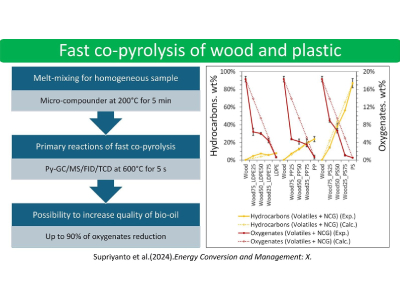
A Swedish researcher has developed a novel technique which can extract large quantities of valuable raw materials from wood and plastic waste. With a focus on the valuable gasses released during the process, the research fills a well-known knowledge gap and deepens our understanding of the gases formed during copyrolysis of wood and plastics.
The copyrolysis method breaks down complex organic materials into valuable gases by heating them to high temperatures in an oxygen free environment.
"In my project, I have particularly investigated the gases that are formed during the initial reactions during copyrolysis. By studying these early reactions, it was possible to determine both the composition and the amount of the gases that were formed," said Supriyanto, Ph.D. in the research area Resource Recovery at the University of Borås, Sweden.
During his research Supriyanto examined how the composition and quality of the resulting gases is dependent on the ratio of wood and plastic as well as the type of plastic used for the copyrolysis. "Some of the most exciting results were the effect of the ratio of wood to plastic. For example, if the wood content is 75%, the formation of oxygen-containing gases is reduced by 90%. If you instead add a catalyst, the total gas yield doubles," he added.
"Copyrolysis has a double advantage. By converting wood and plastic waste into valuable gases, it helps to reduce the amount of pollution and the gases that are formed can be used as renewable raw materials for the production of fuel and valuable chemicals, which promotes a circular economy and contributes to a more sustainable and environmentally friendly future," concluded Supriyanto.