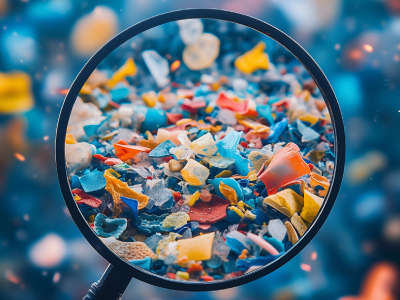
Chemical engineers at Columbia university have discovered the molecular process which causes micro- and nanoscopic plastics to break off in large quantities. It turns out, at least for 75-80% of all plastics in use, the same qualities which make plastic strong and flexible also make it prone to forming nanoplastics.
Plastics are comprised of alternating layers of hard and soft materials, which when stacked together, create a lightweight and flexible material. This alternating of material layers is what gives plastics their unique properties. However, in their paper the Columbia researchers discovered that as these layers degrade over time, micro- and nanoplastics can break off and be released into the environment.
The degradation of plastics begins in the soft layers which grow weaker over time and can break off even when the plastic is not under stress. On their own, the soft pieces can break down relatively quickly in the environment. However, the failing soft layers allow the hard layers to break off and the release of these crystalline fragments are the microplastics that persist for centuries and cause damage to all living things, including humans.
“These pieces float around, and some end up in human bodies. The smallest pieces pass through cells and into the nucleus, where they can start messing with DNA,” said Sanat Kumar. “Nano- and microplastics, which seem to have similar sizes and shapes to asbestos, raise the potential that they could cause cancer, heart disease/stroke, and other diseases.”
“Our results suggest that engineering the architecture of the soft layers to be more resilient would decrease the amount of crystalline fragments that break off,” Kumar concluded. “Clearly, focus needs to be placed on this point to reduce the amount of micro- and nanoplastics created by normal polymer degradation.”