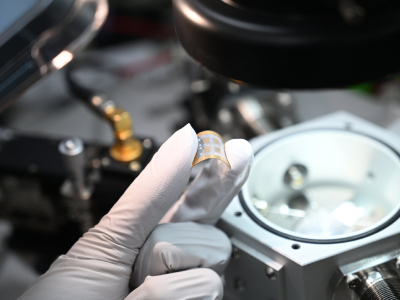
The world's first highly flexible and ultra-sensitive ammonia sensor based on a low-temperature synthesized copper bromide (CuBr) film, developed by the KIMS research team. Credit: Korea Institute of Materials Science (KIMS)
In a world first, researchers have successfully fabricated an ammonia gas sensor based on a copper bromide film fabricated in a simple, low temperature process.
The breakthrough, published in Sensors and Actuators B: Chemical, will enable ultra-sensitive and selective sensing while greatly reducing manufacturing costs.
Ammonia gas sensors commonly rely on copper bromide (CuBr) films as the electrical resistance change experienced upon exposure to ammonia enables detection of even low levels of the gas. However, when using conventional methods, formation of this copper bromide film requires a high temperature vacuum environment, leading to manufacturing challenges and high production costs.
To remedy these issues, the team of researchers developed a novel technique which forms a two-dimensional copper nanosheet at temperatures below 150°C without the need for a vacuum process. Once completed, the nanosheet then undergoes a simple solution-based process to synthesize the copper bromide film.
The sensor developed is capable of detecting concentrations as low as 1ppm, and thanks to its plastic substrate, can tolerate more than 1,000 bending cycles while maintaining its performance and stability.
"The ammonia sensor developed through this study has great potential for expansion into flexible and wearable devices. It can be utilized in a wide range of applications, from indoor air quality monitoring to personal health management," concluded Dr. Jongwon Yoon, the lead researcher. "In particular, we expect that it could be applied as a disease diagnosis sensor by attaching it to the human body to analyze exhaled breath."