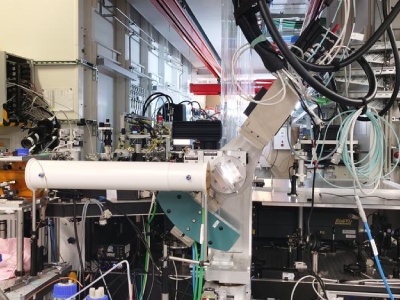
The new Laue spectrometer in position at the FXE instrument of European XFEL. The crystal analyzer in the centre of the image is clearly visible. Credit: European XFEL
Researchers at the European X-Ray Free-Electron Laser Facility (XFEL) have developed a novel spectrometer which can enable X-ray light with photon energies exceeding 15 kiloelectronvolts. The spectrometer, called a High Energy Laue X-ray Emission Spectrometer (HELIOS), improves efficiency and maintains high levels of precision at high photon energies.
The work, published in the Journal of Synchrotron Radiation, describes a new spectrometer which operates in the Laue geometry allowing for meaningful results even at energies well above 15 keV. The spectrometer achieves these measurements by diffracting high energy X-rays with perpendicular atomic layers after passing them through precision cut crystals.
"Our optimized design with a fixed curvature and a short bending radius results in analyzers without noticeable surface distortions, which considerably simplifies the setup and measurement with the Laue spectrometer," said Frederico Lima, scientist at the FXE instrument at European XFEL.
The HELIOS device is now installed and available to all users of the European XFEL, providing researchers with extremely precision of 1.2 x 10⁻⁴ at a photon energy of about 18.6 keV. HELIOS achieves a signal strength of up to 22 times higher than that of traditional spectrometers, making electronic transition detection possible in 4D transition metals.
"The new spectrometer opens up completely new spectroscopic possibilities at high X-ray energies, only possible at the European XFEL," concluded Lima. Examples include the measurement of photocatalytic properties of nanoparticles containing 4D metals, research into dye sensitization for solar cell applications, and the investigation of strongly correlated materials that could be used as superconductors or as battery cathodes or anodes for efficient energy storage.