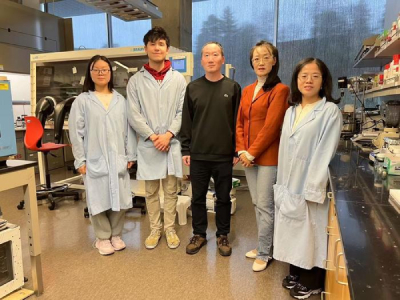
From left to right, PhD student Ying Guo, master's student Justin Zhong, Professors Jin Liu and Katie Zhong, and Postdoctoral Researcher Lulu Ren are studying the use of corn protein to improve lithium-sulfur batteries. Credit: WSU
Washington State researchers have developed a novel method which uses corn protein to improve lithium-sulfur battery performance. The method provides a promising pathway towards expanding use cases for the lighter-weight batteries.
Despite being lighter and more environmentally friendly than their lithium-ion counterparts, lithium-sulfur battery adoption has been limited by hurdles which shorten their lifespan. However, the method recently developed by Washington University researchers could change that.
Their method demonstrates that by using corn protein in combination with a commonly used plastic as a protective barrier, button sized lithium-sulfur battery performance was significantly improved. During testing, the team found that a battery which contained this protective layer, known as a separator, could hold its charge for over 500 cycles, a significant improvement over batteries which lack a separator.
“This work demonstrated a simple and efficient approach to preparing a functional separator for enhancing the battery’s performance,” said Katie Zhong, professor in the School of Mechanical and Materials Engineering. “The results are excellent.”
After demonstrating the battery’s success, the team is now conducting further analysis to demonstrate how the process works and ways in which the protein structure could be optimized.
“A protein is a very complicated structure,” added Zhong. “We need to do further simulation studies to identify which amino acids in the protein structure can work best for solving the critical shuttle effect and dendrite problems.”
To scale the process, the researchers are seeking industry partners to collaborate with while studying larger experimental batteries.