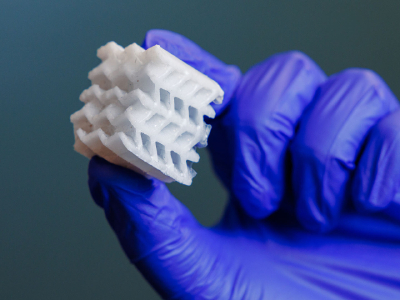
Bendable ceramic origami material created in the UH lab of Maksud Rahman, assistant professor of mechanical and aerospace engineering. The new material could power next-gen prosthetics and aerospace technology. Credit: University of Houston
A team of materials scientists at the University of Houston have developed a novel class of ceramic structures which are capable of bending, without breaking, under pressure. The 3D printed materials could have widespread application in the prosthetic, aerospace, and robotic industries where lightweight durable materials are in high demand.
In the work, published in Advanced Composites and Hybrid Materials, the scientists demonstrate that by using origami inspired shapes and a soft polymer coating, traditionally fragile ceramic materials can be transformed into robust, flexible structures.
"Ceramics are incredibly useful—biocompatible, lightweight and durable in the right conditions—but they fail catastrophically," said Maksud Rahman, assistant professor of mechanical and aerospace engineering. "Our goal was to engineer that failure into something more graceful and safer."
To accomplish that goal the team based their 3D printing design on the Miura-ori origami pattern and then coated the structure in a biocompatible stretchable polymer. The result was a structure which can handle stresses that ordinary ceramics cannot.
"The origami geometry gave us mechanical adaptability," said Md Shajedul Hoque Thakur, a postdoctoral fellow. "And the polymer coating introduced just enough flexibility to prevent sudden breakage."
"Origami is more than an art—it's a powerful design tool that can reshape how we approach challenges in both biomedical and engineering fields," concluded Rahman. "This work demonstrates how folding patterns can unlock new functionalities in even the most fragile materials."