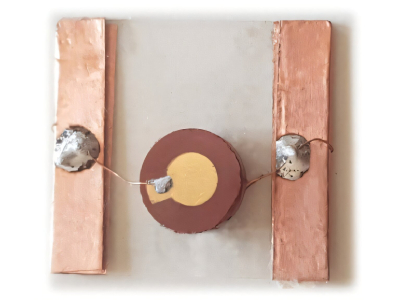
The polycrystalline powder was pressed into a dense pellet with a diameter of 10 mm. Credit: HZB
HZB researchers have discovered that two new bismuth-based organic-inorganic hybrid materials can achieve highly efficient X-ray detection, potentially creating a new technique which can lower radiation doses while improving detection sensitivity.
In addition to their lower radiation dose, the materials can be created using ball milling, a particularly environmentally friendly manufacturing process in which polycrystalline powders are pressed into dense pellets. Ball milling is a well-established manufacturing method within the industry.
The research conducted by the team, which is published in Advanced Materials, included extensive laboratory analysis as well as analysis using the KMC-3 XPP beamline at BESSY II. During pulsed X-ray irradiation under high-intensity photon flux the detector materials maintain stable response with no degradation in performance after exposure, highlighting how robust the materials are.
"We have shown that these entirely new bismuth-based materials are excellent candidates for X-ray detection. Our results highlight exciting opportunities to expand hybrid materials research at HZB beyond photovoltaics, both within and beyond the perovskite field. More sensitive X-ray detectors would allow to significantly reduce radiation exposure during X-ray imaging," concluded Olena Maslyanchuk.
"The results show that they perform better than current commercial detectors, even over long periods of time," added Dr. Allan Starkholm. "In fact, they demonstrate sensitivities up to two orders of magnitude higher than commercial materials like amorphous selenium or CdZnTe—and can detect X-ray doses nearly 50 times lower."