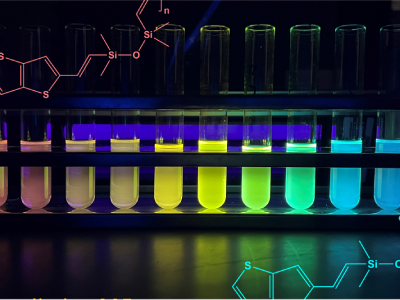
Test tubes containing the new silicone copolymers, separated by chain length, from long to short provide visual evidence of the varying band gap in the new semiconductor silicone. Shining a UV light creates a rainbow of beakers as the longer chain lengths shift towards the red end of the electromagnetic spectrum, requiring less energy to absorb and emit light at lower energies. Credit: Zijing (Jackie) Zhang.
Researchers at the University of Michigan have discovered a novel silicone variant which can act as a semiconductor, refuting previous assumptions that the materials are exclusively insulating.
Traditionally, silicone oils and rubbers are used as insulating materials, and given their water-resistant properties, well suited for use in biomedical devices, coatings, and other similar applications. On a molecular level, these materials contain alternating silicon and oxygen atoms that form a sort of backbone.
During their recent study of cross linking structures in silicone, the team of researchers happened upon the electrical conductivity potential of a silicone copolymer. This conductivity possibility arises from the way in which electrons move across the silicon oxygen bonds with overlapping orbitals. While typical silicon oxygen bond angles do not allow for electron transport due to their 110° angle, silicone copolymer bonds are 140° in ground state and stretch to 150° in the excited state, an angle that proved to be enough to create an electrical charge highway.
"This allows an unexpected interaction between electrons across multiple bonds including Si—O—Si bonds in these copolymers," said Richard Laine, U-M professor of materials science and engineering and macromolecular science and engineering. "The longer the chain length, the easier it is for electrons to travel longer distances, reducing the energy needed to absorb light and then emit it at lower energies."
Additionally, the team discovered that the copolymer chain length directly impacts the materials light emission properties. Longer chains resulted in lower energy photons and a red light emission, while shorter chains increase energy and moved the color towards the blue end of the spectrum. This colorful array of light emission is very unique because up to this point, traditional silicones have only been white or transparent because they absorb too much light.
"The material opens up the opportunity for new types of flat panel displays, flexible photovoltaics, wearable sensors or even clothing that can display different patterns or images," added Laine.
"We're taking a material everyone thought was electrically inert and giving it a new life—one that could power the next generation of soft, flexible electronics," concluded Zijing (Jackie) Zhang, U-M doctoral student of materials science and engineering and lead author of the study.