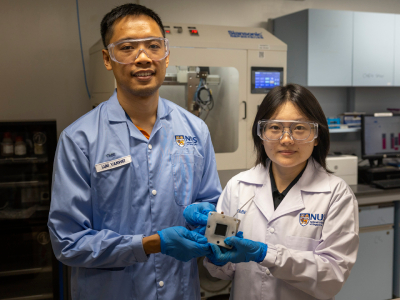
Assistant Professor Lum Yanwei (left) with Yang Qin (right), first author of the research, holding a sample of the catalyst they developed. Credit: College of Design and Engineering at NUS
Researchers from the National University of Singapore (NUS) have developed a novel method which can convert carbon dioxide into ethylene using significantly less energy than traditional methods. The new copper-based cobalt doped catalyst could help cut emissions in one of the worlds most carbon-intensive manufacturing processes.
"By making precise changes at the atomic level, we were able to shift the most energy-demanding step in the reaction, which makes the overall process much more efficient," said Assistant Professor Lum Yanwei from the Department of Chemical and Biomolecular Engineering at NUS. "This makes the process far more practical for industrial applications."
The catalyst, describe in a recent publication in the journal Nature Synthesis, was tested in a membrane electrode assembly which allows efficient gas flow and product separation. According to their work, the new catalyst delivers ethylene output with more than 25% energy efficiency while remaining stable for over 100 hours of continuous operation.
"We also showed that the catalyst performed well, producing ethylene from low-purity CO2, such as that found in industrial flue gas," added Lum. "This improves its potential for real-world deployment."
If powered by affordable renewable energy, the novel catalyst could product ethylene at a cost comparable to conventional methods. With demand for ethylene rising globally, a production method which lowers carbon emissions could have a significantly positive environmental impact.