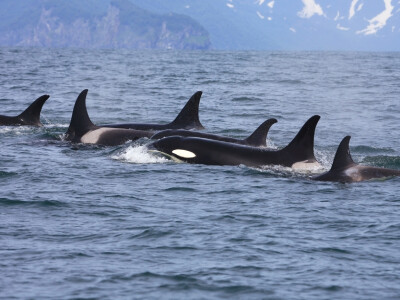
A previously undocumented class of PFAS has been identified in the blubber of killer whales by a team of Swedish scientists. While most of the well-studied PFAS compounds accumulate in protein-rich tissues, this new highly fluorinated class accumulates in fat-rich tissue.
"This is the first time that highly fluorinated PFAS has been shown to preferentially accumulate in fat," said Mélanie Lauria, formerly a doctoral student at the Department of Environmental Science at Stockholm University and currently at the Swiss Federal Institute of Aquatic Science and Technology (EAWAG).
"It challenges the long-held assumption that PFAS primarily binds to proteins and accumulates in the liver or blood. Research has so far focused on a subgroup of PFAS that is 'charged' or 'polar," and therefore interacts mainly with proteins. The results of this study show that we have overlooked PFAS that are neutral and can interact and accumulate in neutral fats such as blubber."
Published in the journal Environmental Science and Technology Letters, the work reveals the presence of five fluorotelomer sulfones, highly fluorinated lipophilic chemicals which have never before been reported in wildlife.
Relying on advanced mass spectrometry techniques, the team analyzed killer whale tissue samples from Greenland and Sweden where they found five fluorotelomer sulfones made up nearly 75% of the fluorine containing substances in the blubber. The compounds were notably absent from liver tissue.
"These findings suggest that we may be underestimating the PFAS body burden in marine mammals. Blubber can represent up to half of a marine mammal's body mass, so neglecting fat-soluble PFAS could significantly undermine the accuracy of exposure assessments," said Jonathan Benskin, professor at the Department of Environmental Science at Stockholm University.
The study raises new questions regarding PFAS exposure in apex predators, and poses new concerns for human health, particularly in artic regions where marine mammals are commonly found in traditional diets.