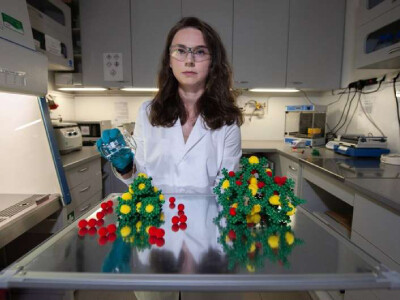
Scientists from the Institute of Physical Chemistry of the Polish Academy of Sciences have developed an innovative porous material for environmental protection. Changing the solvent and temperature allows for reversible modification of the metal clusters-based structure, enabling efficient separation of various gases. Credit: Grzegorz Krzyzewski
Robust noncovalent microporous materials (NPMs) have garnered increased attention recently in the world of supramolecular chemistry, but despite the interest development of robust porous functional frameworks remains a challenge in their widespread adaption.
Recently, a team of researchers from the Institute of Physical Chemistry, Polish Academy of Sciences in Warsaw and Warsaw University of Technology has developed an efficient method which can be used to prepare a nanosized Ni(II) hydroxyquinolinato(L)-carbonato(CO3) cluster, [Ni10(μ6-CO3)4(L)12].
"This decanuclear cluster, depending on the crystallization conditions, self-assembles into either of two microporous frameworks: diamondoid WUT-1(Ni) and pyrite WUT-2(Ni). The transitions between both polymorphs can also be selectively triggered by temperature or exposure to vapors of a particular organic solvent, which is accompanied by the easy recovery of crystallinity by the materials from the noncrystalline phase," said Dr. Iwona Justyniak, co-author of the study.
In the research, published in the Journal of the American Chemical Society, both materials demonstrated excellent thermal and chemical stability under both aerobic and aqueous conditions. Additionally, the materials exhibited unique gas adsorption properties, with WUT-1(Ni) exhibiting significant gas uptake enhancements and WUT-1(Zn) showing one of the highest H2 uptakes among NPMs.
By demonstrating the profound impacts of metal centers in the self-assembly of isostructural nanoclusters, the research conducted by the team will aid future research into developing advanced porous solid-state materials.