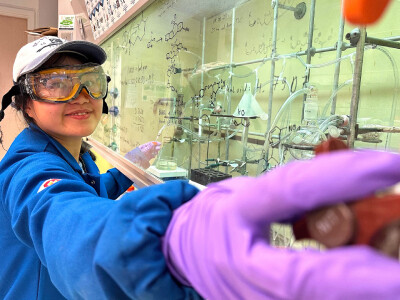
Credit: Carol Clark, Emory University
Emory University chemists have developed a new approach to an existing reaction which boosts vinylic ether synthesis. The method results in improved reliability, yield, and generality in the Chan-Evans-Lam reaction.
"Our method is easy to reproduce and is based on widely available and inexpensive compounds," says San Pham, an Emory Ph.D. candidate and first author of the paper. "We can apply this method to make multiple natural products, including novel vinylic ethers."
The work, published in the journal Organic Letters, improves upon the 25-year-old Chan-Evans-Lam reaction used to synthesize vinylic ethers. Vinylic ethers are important synthetic intermediates used to synthesize several bioactive compounds such as plasmalogen.
While the Chan-Evans-Lam reaction works well with simple reactants, researchers often run into hurdles such as low yields when using complex reactants, making it impractical for vinylic ether synthesis.
"San Pham demonstrated that our new method works for several combinations of reactants, producing at least 15 new compounds that were previously unknown and would likely have been quite difficult to prepare using other known synthetic strategies," added Frank McDonald, Emory professor of chemistry.
The enhancements discovered by Pham resulted in a boost of nearly 80% to target compound yield, while reducing unwanted byproducts and increasing reaction speed.