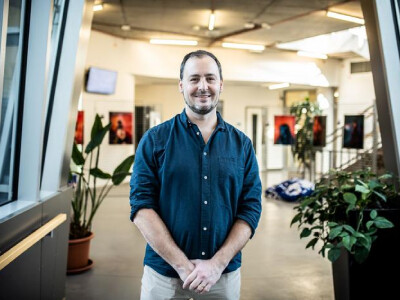
Dr. Tomáš Pluskal, head of the Biochemistry of Plant Specialized Metabolites group at IOCB Prague. Credit: Tomáš Belloň/IOCB Prague
Thanks to an extensive new library created by the Institute of Organic Chemistry and Biochemistry of the Czech Academy of Sciences (IOCB Prague), researchers from around the world can now identify previously unknown compounds. The library, called MSⁿLib, contains several million records which show how small molecules break apart while being analyzed by mass spectrometry.
During analysis, mass spectrometry breaks compounds into smaller parts before allowing scientists to determine the structure of the original molecule using the fragments. Once analyzed, these fragment spectra are then compared to known spectra stored within libraries. However, existing libraries only cover a limited number of known compounds, making the search more difficult.
With their recent work on MSnLib, Dr. Tomáš Pluskal and his team at IOCB Prague have significantly improved the development of future spectral libraries. At the time of publication in Nature Methods the team had compiled a library of thirty thousand small molecules, comprised of two million high-quality spectra. By employing multistage fragmentation (MSⁿ) in the process, the team obtained very detailed views of the internal structure of the molecules.
“During the twenty years I’ve worked in this field, spectral libraries have not expanded much. We managed to change this practice and created the largest database currently in existence. Moreover, we’ve made it openly available to the global scientific community,” said Pluskal.
“Since writing the article in Nature Methods, we’ve advanced further. So far, we’ve processed about 70,000 compounds, and we have another 150,000-awaiting analysis. We continue uploading data online, and by the end of the year we’d like to reach 200,000 measured compounds. That’s roughly ten times more than has been available over the past twenty years,” added first author, Dr. Corinna Brungs.
The library was created using open-source software, which makes the library not only extensive, but easily accessible for further research around the world.