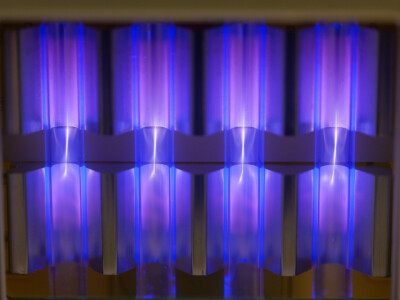
UV222 lights hang on the ceiling of the Aerobiology and Disinfection Laboratory at CU Boulder. Credit: Patrick Campbell/CU Boulder
UC Boulder Researchers have developed a unique, UV method, which can disable indoor allergens. Even after removing the source, indoor allergens including dust mites, mold, and cats can persist for months.
"We have found that we can use a passive, generally safe ultraviolet light treatment to quickly inactivate airborne allergens," said Tess Eidem, a senior research associate in the Department of Civil, Environmental and Architectural Engineering. "We believe this could be another tool for helping people fight allergens in their home, schools or other places where allergens accumulate indoors."
The device, described in the journal ACS ES&T Air, uses 222-nanometer-wavelength lights to disable the allergen causing protein, a less intense alternative to commercially used UV disinfectant lights that is safer for use in occupied spaces. During their analysis the team demonstrated a 20% to 25% reduction in airborne allergens after just 30 minutes. Overall efficacy was variable based on the allergen and UV light run time.
"Those are pretty rapid reductions when you compare them to months and months of cleaning, ripping up carpet, and bathing your cat," added Eidem.
UV222 lights are readily available and currently used primarily for industrial antimicrobial uses. The team Invision engineers developing portable UV222 devices which could be switched on during allergen exposures to lessen their effects. With one in three people in the United States having allergies, Eidem hopes that her research, along with further development, can potentially save lives.
"Asthma attacks kill about 10 people every day in the United States, and they are often triggered by airborne allergies," she concluded. "Trying to develop new ways to prevent that exposure is really important."