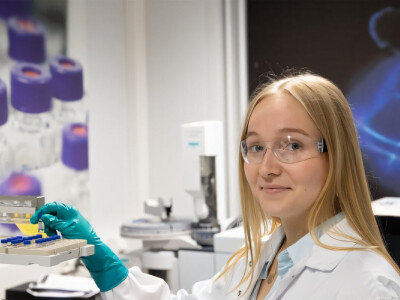
VERIFIN has the capability to identify and analyze chemical warfare agents. Doctoral researcher Solja Säde in the picture. Credit: Jani Närhi
Solja Säde, a doctoral researcher at the Finnish Institute for Verification of the Chemical Weapons Convention VERIFIN, University of Helsinki, has developed new methods of chemical forensics in her recent doctoral thesis.
"The goal was to promote methodological development in the field overall and to facilitate the standardization of methods," Säde added.
Despite being prohibited under the Chemical Weapons Convention (CWC), the development and use of chemical warfare agents have continued in conflicts around the world, including deployment of riot control agents in Ukraine in both 2024 and 2025.
"These events make it extremely important to develop methods of chemical forensics to determine the perpetrators responsible for using chemical warfare agents," said Säde.
Established to oversee the prohibition of chemical weapons, the Organization for the Prohibition of Chemical Weapons (OPCW) currently analyzes samples using gas, and liquid chromatography in laboratories throughout the world. According to Säde, standardizing these testing methods is important to make results comparable and to ensure validity and increase reliability in potential court proceeding.
As part of her research, Säde developed a novel method which can be used to identify the link between chemical agents and the origins of the substances used for their production. Additionally, this method could be used to further extract important forensic information on chemical agents used in future attacks.
Säde also developed a method, based on a newly developed QC sample, which can ensure optimal functioning of GCMS instruments for the purpose of chemical forensics. By standardizing instruments using this standard, data can be compared across labs and methodologies.
Säde and her colleagues will be publishing the final portion of her thesis in an article titled "Comparison of statistical multivariate analysis methods for chemical forensics profiling of a carbamate chemical warfare agent precursor", which will provide a closer look at statistical classification currently used in chemical forensics.