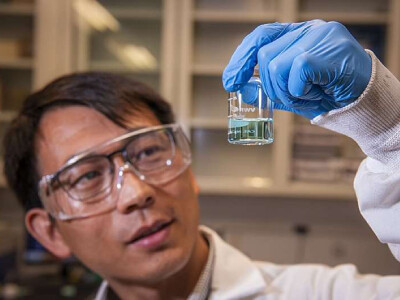
First author Qiubo Zhang looks at a sample of high-entropy alloy in solution made using the team's new technique. Credit: Robinson Kuntz/Berkeley Lab
Lawrence Berkeley National Laboratory researchers have discovered a new method to produce high-entropy alloys (HEAs) at near room temperatures. Additionally, the method provides increased control over the alloy’s crystal structure and overall morphology.
First discovered nearly 20 years ago, HEAs are of great interest to several industries thanks to their record-breaking strength and toughness. Additionally, the material could serve as a catalyst, potentially boosting efficiency and durability of batteries and fuel cells. While most catalysts typically contain a high proportion of one element with lower amounts of additional elements mixed in, HEAs are comprised of equal ratios of elements, leading to a structure with more entropy.
While this entropy is key to HEA function, achieving the high entropy involves heating the elements to high temperatures before mixing to induce a high kinetic energy and then rapidly dropping that temperature to lock in the state of internal disorganization from the energetic atoms.
The Berkeley Lab method, described in the journal Nature, achieves this same high entropy result at significantly lower and more constant temperatures by mixing the elements in their water based chloride form with liquid metal gallium. After the acidic liquid contacts the liquid gallium, the elements shed their chloride atoms and mix together before solidifying into an HEA alloy.
The team has begun working to accelerate the design of new HEAs, and hope to move HEAs from promising experimental applications to real-world products.