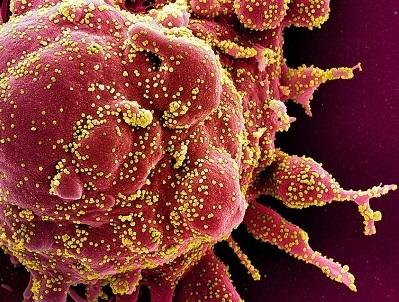
Credit: Image captured at the NIAID Integrated Research Facility (IRF) in Fort Detrick, Maryland.
For the second time during the COVID-19 pandemic, the FDA has granted an Emergency Use Authorization for a drug to treat an illness beside the indication it was initially developed for.
Late Friday, the FDA sent a letter to Gilead, the pharmaceutical manufacturer behind remdesivir, approving the emergency use of the drug for the treatment of hospitalized COVID-19 patients. The announcement comes less than two days after an NIH study of hospitalized patients with advanced COVID-19 and lung involvement who received remdesivir recovered faster than similar patients who received a placebo.
Remdesivir is a direct acting antiviral drug that inhibits viral RNA synthesis. It is an investigational drug and is not currently approved for any indication.
“Based on review of the topline data from the randomized, double-blinded, placebo-controlled trial conducted by NIAID and from the Gilead-sponsored open-label trial that evaluated different durations of remdesivir, it is reasonable to believe that the known and potential benefits of [remdesivir] outweigh the known and potential risks of the drug for the treatment of patients hospitalized with severe COVID-19,” wrote Denise Hinton, FDA Chief Scientist, in the letter.
On February 21, the National Institute of Allergy and Infectious Diseases (NIAID), part of NIH, began a randomized, controlled trial involving 1,063 hospitalized patients with advanced COVID-19. Preliminary results indicate that patients who received remdesivir had a 31% faster time to recovery than those who received the placebo. Specifically, the median time to recovery was 11 days for patients treated with remdesivir compared with 15 days for those who received placebo. Results also suggest a survival benefit, with a mortality rate of 8% for the group receiving remdesivir versus 12% for the placebo group.
The Emergency Use Authorization allows both 5- and 10-day treatment durations, with the latter intended for patients requiring mechanical ventilation. Gilead’s global Phase 3 study—as referenced in the FDA letter—established and evaluated the 5- and 10-day dosing durations in patients with severe disease.
Possible side effects of remdesivir include nausea, low blood pressure and an increase in liver enzymes associated with inflammation or damage to the organ. Hydroxychloroquine—the first and only other drug granted Emergency Use Approval to treat COVID-19—has shown more severe side effects, possibly causing fatal heart issues in some patients. On April 24, the FDA issued a warning against using hydroxychloroquine unless absolutely necessary.
Gilead has donated more than 1.5 individual doses of remdesivir to treat patients, and said it has already “implemented a multipronged approach to scale up production and rapidly build supply.”